To use Polymarket, sign up with an email or Google account, fund your balance with USDC (it runs on the Polygon blockchain), then pick a market, read the price as an implied probability, and buy Yes or No shares between 0 and 1 dollar each. The correct outcome pays 1 dollar per share when the market resolves, and you can sell early before that. Polymarket is a peer-to-peer prediction market, not a sportsbook, and access depends on your jurisdiction, so check Polymarket's own rules. You must be 18+ and should only risk what you can afford to lose.

If you have read our other guides you already know we lean on Polymarket as the cleanest way to bet on League of Legends. This piece is the missing manual. We are going to explain exactly how to use Polymarket from a standing start, the way we would walk a friend through it the first time, with no hand-waving over the parts that actually cost you money.
Polymarket is not a sportsbook. That single fact changes everything about how you use it, so we will start there and keep coming back to it. On a sportsbook you bet against the house. On Polymarket you trade with other people, and the price you pay is the crowd's live estimate of how likely an outcome is. Once that clicks, the rest of the platform stops feeling strange.
We will cover the whole loop: what a prediction market is, creating an account, funding it with USDC on Polygon, finding a market such as a Worlds winner, reading the price as a probability, buying a Yes or No share, selling before the market ends, how resolution pays out, the fees, and the big honest caveat about where Polymarket is and is not available.
We track LoL prediction markets at RiftOdds every split, so everything below comes from watching real markets move through real tournaments. You must be 18 or over to follow along, and the only sane way to do any of this is with money you are genuinely fine losing. Let us get into it.
What is Polymarket, and how does Polymarket work?
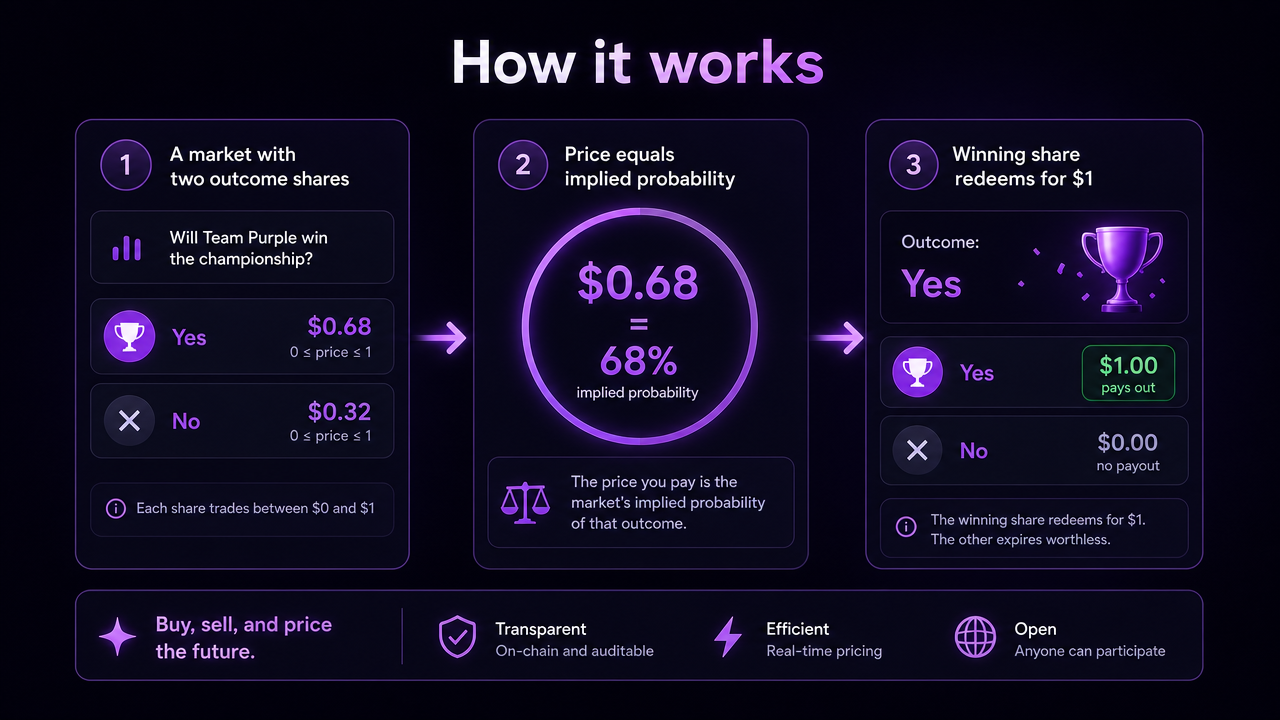
Polymarket is a prediction market. Every question is a binary, Yes or No market with two outcome tokens, and each share is priced between 0 and 1 dollar. The price is the implied probability. A share trading at 0.40 means the market thinks that outcome is about 40 percent likely. If you are right, each share you hold pays out 1 dollar when the market resolves. If you are wrong, it is worth nothing.
Here is the part that trips up newcomers. There is no bookmaker setting odds and skimming a margin. Polymarket runs an order book, so your order gets matched against another trader who is taking the opposite side. When Yes and No orders add up to 1 dollar, they match and shares are created. That is what we mean by peer-to-peer, and it is closer to a betting exchange or a stock exchange than to a traditional sportsbook.
It runs on crypto rails. Polymarket is built primarily on the Polygon blockchain and settles in USDC, a stablecoin pegged one-to-one to the US dollar. You do not need to be a crypto person to use it, but you do need to understand that your balance lives on a blockchain, which is why deposits and withdrawals work a little differently from a normal betting app.
Creating your Polymarket account
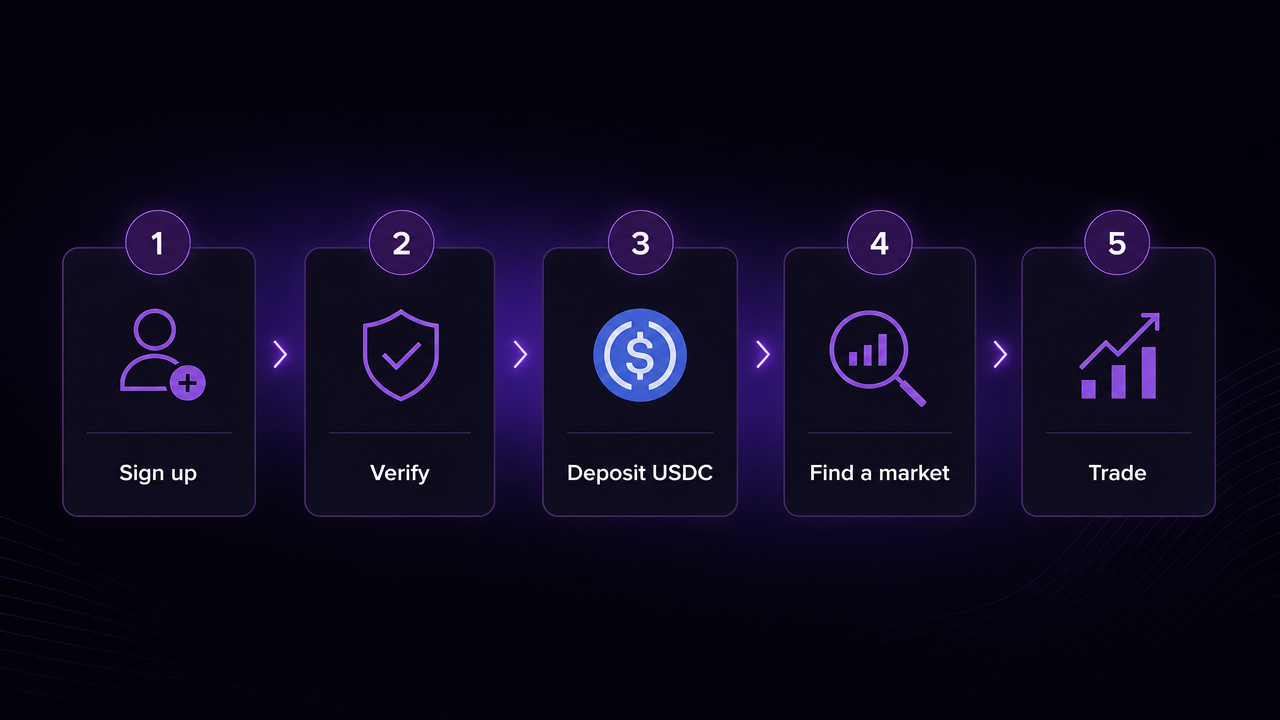
Signing up is quick. You head to Polymarket, choose Sign Up, and continue with either an email address or a Google account. If you use email, you confirm with a code sent to your inbox, then pick a username and agree to the Terms of Use. There is no long form to fill in at this stage.
You can browse and read every market without an account. Polymarket is viewable in well over 180 countries, and the live prices are public. Creating an account is only the step that lets you hold a balance and place trades, so there is no harm in looking around first to get a feel for how markets are laid out.
One thing to expect: identity verification. You do not need to hand over personal details just to register, but Polymarket requires you to verify your identity before you deposit or withdraw, which means your full name, date of birth, address, and a government-issued photo ID. The details have to match the ID exactly. This is standard for a regulated venue, so have your ID ready before you try to fund the account.
Ready to try it on a live LoL market?
Open PolymarketFunding your account with USDC on Polygon
Polymarket operates entirely in USDC, so every deposit ends up as USDC you can trade with. There are two broad ways to get there, and which one suits you depends on whether you already hold crypto.
If you already have crypto, you transfer it in. Inside the app you click Deposit, choose Transfer Crypto, then pick the token and network. Each account is assigned a fixed deposit address tied to your profile, so you copy that address and send funds to it. The cleanest route is sending USDC on the Polygon network, because that is the chain Polymarket settles on. If your USDC is sitting on Ethereum mainnet or another chain instead, Polymarket's bridge converts incoming deposits for you, but it is worth understanding which network you are sending on so funds land where you expect.
If you do not hold crypto, you can buy in with a card or another familiar method. Polymarket integrates third-party on-ramps such as MoonPay and others, which let you fund with a credit or debit card, and depending on region, bank transfer or PayPal, converting your money into USDC behind the scenes. This is the simpler path for most beginners.
A few rules to internalise before you send anything:
| Deposit method | Best for | Watch out for |
|---|---|---|
| Transfer USDC on Polygon | People who already hold crypto | Send on the right network, addresses are not reversible |
| Transfer USDC from another chain | Crypto held on Ethereum or elsewhere | Bridge conversion, and minimum thresholds before funds clear |
| Card or on-ramp (MoonPay etc.) | Beginners with no crypto | Third-party fees from the on-ramp provider, not Polymarket |
Two warnings we cannot repeat enough. First, blockchain transactions cannot be reversed, so always verify the network and the deposit address before you send. Second, deposits below a minimum threshold can sit pending until the cumulative amount clears the minimum, so do not panic if a tiny test deposit does not show up instantly.
Finding a market, including a LoL one
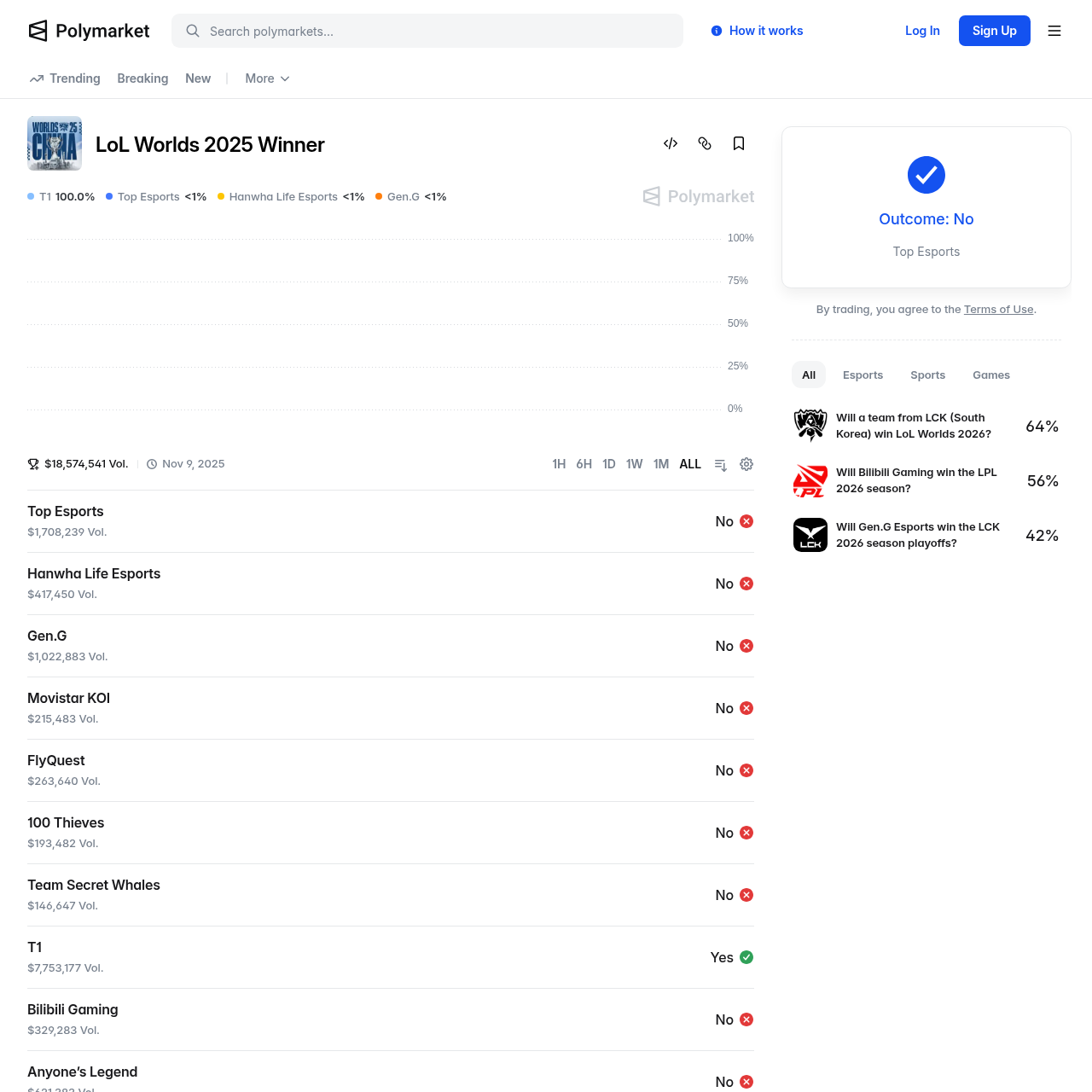
Once you are funded, the fun starts. The top menu sorts markets into Trending, Breaking, and New, and you can browse by category: Politics, Sports, Crypto, Finance, Tech, Culture, and more. Esports lives under Sports, alongside football, basketball, tennis, and the rest.
For League of Legends specifically, you are looking for event markets tied to the calendar: a Worlds winner, an MSI champion, a regional split title, or a single best-of series. A typical LoL market reads something like "Will T1 win Worlds 2026?" with Yes and No shares. If you want the deeper context on which LoL markets are worth your attention and how to read team form into them, our companion piece on how to bet on League of Legends goes market by market, and our Worlds hub tracks the big international event as prices move.
Use the search and filters to narrow things down rather than scrolling forever. Pay attention to two numbers on every market card: the price, which is the implied probability, and the volume or liquidity, which tells you how easily you can get in and out without moving the price against yourself. Thin markets are harder to trade.
Reading the price as a probability
This is the single most useful skill on the platform, so slow down here. Every share is priced between 0 and 1 dollar, and that price is the market's estimate of probability. A Yes share at 0.65 means the crowd reckons there is roughly a 65 percent chance of that outcome. The Yes and No prices on a clean two-sided market add up to about 1 dollar, because between them they cover every possibility.
The payout math falls straight out of that. If you buy a Yes share at 0.40 and the outcome happens, that share is redeemed for 1 dollar, so your profit is 0.60 per share. If it does not happen, the share is worth 0. That asymmetry is the whole game: cheap shares pay more if they hit, expensive shares hit more often but pay less. We break the conversion between these prices and traditional odds formats in our guide to LoL betting odds, which is worth a read if decimal and American odds are more familiar to you.
Because the price is a live probability, it moves as news breaks and as other traders pile in. A roster change, a patch, or a shock loss in the group stage will reprice a market in minutes. That movement is exactly what lets you sell early for a profit or a loss before the event even finishes.
How to place your first trade
Here is the part you came for. Once your account is funded and you have found a market you have a genuine read on, placing a trade looks like this.
Your first trade, step by step
- Open the market. Click into the LoL market you want, for example a Worlds winner or a single series.
- Choose your side. Decide whether you are buying Yes or No, based on what you think will actually happen, not which side is more popular.
- Check the price. Read the current share price as a probability and sanity-check it against your own estimate. If you think the true chance is higher than the price, the Yes side is interesting, and vice versa.
- Enter your amount. Type how much you want to spend. The interface shows how many shares that buys and your maximum payout if you win.
- Place the order. Confirm. A simple market order fills against existing orders right away, and your shares land in your portfolio.
- Watch it in your portfolio. Your open positions, their current value, and your profit or loss all live in your portfolio, where you also manage selling.
That is genuinely it. There are advanced order types if you want them, limit orders that wait for a price you name rather than filling instantly, but a market order is all you need for a first trade. One note for live esports: on sports markets, resting limit orders are automatically cancelled when the game starts, which clears the book at the official start time, so do not rely on a limit order sitting open into a live series.
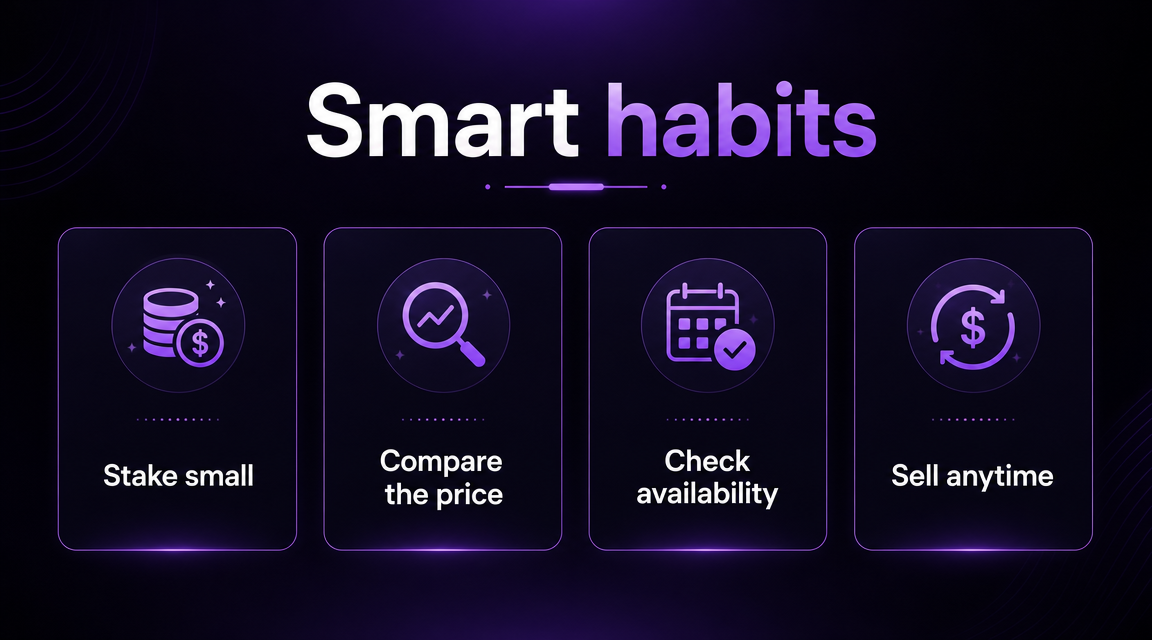
Selling early versus holding to resolution
You are never locked in until the event ends. Because every share has a live price, you can sell your position any time the market is open, which is one of the biggest differences from a normal bet slip.
| Sell before resolution | Hold to resolution | |
|---|---|---|
| What happens | You sell your shares at the current price to another trader | You wait for the market to settle |
| Payout | Whatever the share is worth right now, more or less than you paid | 1 dollar per winning share, 0 per losing share |
| Why do it | Lock in a profit early, or cut a loss before the result | Capture the full payout if you are confident you are right |
| Risk | You might sell before a price you wanted, thin markets can be hard to exit | An outcome can swing on a single teamfight |
In practice plenty of traders never hold to the end. If your team jumps out to a 2 to 0 lead in a best-of-five and your Yes shares have climbed from 0.40 to 0.85, selling there locks in most of the gain without risking the reverse sweep. That flexibility is a feature, and it rewards watching the games you bet on. Our match schedule is the easiest way to know when a series you have a position on is about to go live.
How markets resolve and pay out
When the real-world event concludes, the market resolves to its correct outcome. Every winning share is redeemable for 1 dollar in USDC and every losing share goes to zero. If you held T1-to-win-Worlds Yes shares and T1 win, each share you own is now worth a clean dollar.
Resolution is determined by the verifiable outcome of the question, not by a house deciding to pay you. That is part of why prediction markets feel transparent: the rules for what counts as Yes are spelled out on the market page before you ever trade, and you can read them. Always read those rules, because the edge cases (a forfeit, a postponed series, a tournament format change) are exactly where careless traders get surprised.
Once a market settles, your USDC balance updates and you can either redeploy it into another market or withdraw it. Withdrawing sends USDC back out to a crypto wallet or off-ramp of your choosing, the reverse of how you funded in.
What it costs: Polymarket fees
Fees are refreshingly light, but they are not always zero, so let us be precise. Polymarket charges no fee to deposit or withdraw USDC, though a third-party on-ramp such as MoonPay or an exchange may charge its own fee on the way in.
On trading, only takers pay a fee, the side that fills an existing order, and makers who post orders pay nothing. The fee rate varies by category and is calculated in USDC at match time, so you never type it into an order. It is small: for sports markets the rate works out to under two dollars on a hundred-share trade even at the most expensive point, and the fee is largest at a 50 percent price and shrinks toward both extremes. Some categories, notably geopolitics and world-events markets, are fee-free entirely. The practical takeaway is that fees are a rounding error compared with picking the wrong side, so spend your energy on the read, not the fee.
The big caveat: where Polymarket is available
This is the part we will not gloss over, and we are not lawyers, so treat this as orientation rather than legal advice. Availability depends entirely on your jurisdiction, and the rules change, so the only authoritative source is Polymarket's own terms and its availability page. Check those before you assume you can trade.
The headline as of mid-2026: the global Polymarket interface was blocked to US users after a 2022 regulatory settlement, but late in 2025 the US Commodity Futures Trading Commission cleared Polymarket to operate as a regulated, federally supervised prediction-market exchange. In plain terms, Polymarket is now permitted to serve US traders under a regulated structure, but access has been rolling out gradually, gated behind a waitlist and invite codes rather than open to everyone at once. If you are in the US, expect identity verification and expect the experience to differ from the global site.
Outside the US, Polymarket is viewable across a great many countries, but plenty of jurisdictions restrict or block participation, and being able to see prices is not the same as being allowed to trade. The responsible move is the same everywhere: confirm it is permitted where you are, make sure you are 18 or over, and only ever risk money you can afford to lose. Prediction markets are entertainment, not an income plan, and treating them otherwise is how people get hurt.
FAQ
Is Polymarket legal in the US?
It is moving in that direction. After a 2022 settlement blocked US access, the CFTC issued an amended order in late 2025 clearing Polymarket to operate as a regulated US prediction-market exchange, but rollout has been gradual and gated by a waitlist and invite codes. Legality and access depend on your situation and can change, so check Polymarket's own availability page and terms rather than taking our word for it. This is not legal advice.
How do you deposit money on Polymarket?
Click Deposit, then either transfer crypto or buy in with a card. Polymarket settles in USDC on the Polygon blockchain, so the cleanest route if you hold crypto is sending USDC on Polygon to your account's fixed deposit address. If you do not hold crypto, a third-party on-ramp like MoonPay lets you fund with a card and converts to USDC for you. You verify your identity before depositing.
How does Polymarket make money, and what are the fees?
There are no Polymarket fees to deposit or withdraw USDC. On trades, only takers pay a small fee calculated in USDC at match time, makers pay nothing, and some categories such as geopolitics are fee-free. The fee is small, largest around a 50 percent price and shrinking toward the extremes, and it funds rebates that reward market makers for providing liquidity.
Can you withdraw from Polymarket?
Yes. Once a market resolves or you sell a position, your USDC balance is yours to withdraw. Withdrawals send USDC back out to a crypto wallet or off-ramp, the reverse of funding. Polymarket itself does not charge a withdrawal fee, though an intermediary you cash out through may. You will need to have completed identity verification.
Is Polymarket a sportsbook?
No, and this is the key thing to understand. Polymarket is a peer-to-peer prediction market, closer to a betting exchange or stock exchange than a bookmaker. You trade Yes or No shares with other users at prices that reflect live probability, rather than betting against a house that sets the odds and takes a margin.
Can you bet on esports on Polymarket?
Yes. Esports markets, including League of Legends, sit under the Sports category. You will find markets for Worlds and MSI winners, regional split titles, and individual series, all as Yes or No shares priced as probabilities, the same way every other Polymarket market works.