You open a tab, see "T1 1.45 / opponent 2.75", and your eyes glaze over. Or you land on a prediction market and a team is "trading at 62 cents" and you have no idea whether that is good or bad. Most LoL fans can tell you who should win a series, but freeze the moment numbers get involved. That gap is exactly where people overpay for favourites and ignore underdogs that are actually worth backing.
It matters because odds are the price you pay for an opinion. Misread them and you can back a team you love at a number that gives you no edge whatsoever, or skip a perfectly fair price because the format looked scary. Reading odds well is the single most transferable skill in betting on League of Legends, more useful than knowing any one team's scrim form.
By the end of this guide you will be able to read decimal, American, and prediction-market odds, convert any of them into a plain win probability in your head, work through a real numeric example, and understand how Polymarket prices a team as a live 0 to 100 percent share. We will also walk through favourites, underdogs, why prices move, and the common market types you will see across the LoL calendar.
We run RiftOdds, we watch LCK, LEC, LPL, and Worlds odds move in real time every split, and we have made every reading mistake in this article at least once. Everything below is written the way we wish someone had explained it to us. None of it is betting advice, and odds are probabilities, not promises. You must be 18 or older (21 in some places) and only ever stake money you are fully prepared to lose.
What betting odds for League of Legends actually represent
Strip away the formatting and every set of betting odds for League of Legends is doing one job: expressing how likely an outcome is, and what you get paid if it happens. A team that "should" win 8 times out of 10 will carry short odds and a small payout. A team that wins maybe 3 times out of 10 will carry long odds and a fat payout. The odds and the implied probability are two sides of the same coin.
The key idea is implied probability: the win chance baked into a price. Once you can pull the implied probability out of any odds format, the format stops mattering. You are no longer reading "1.45" or "+200" or "62 cents", you are reading "about 69 percent", "about 33 percent", "about 62 percent". That is the number you actually reason about.
One honest caveat before we go further. With traditional bookmaker odds, the implied probabilities across all outcomes add up to slightly more than 100 percent. That extra slice is the bookmaker's margin (the "vig" or "overround"), the built-in edge that pays the house. We will come back to why prediction markets handle this differently, because it is one of the biggest practical reasons people prefer them.
The three odds formats you will meet
There are three formats you need to recognise on sight. Two are classic sportsbook formats, and the third is the prediction-market style used by Polymarket, where the price itself is the probability.
Decimal odds
Decimal odds (popular in Europe and most of the world) show your total return per unit staked, stake included. A team at 1.45 returns 1.45 units for every 1 unit you risk, so a winning 10 unit bet returns 14.50 (a 4.50 profit). The implied probability is simply 1 divided by the decimal: 1 / 1.45 is about 0.69, or 69 percent.
American (moneyline) odds
American odds use a plus or a minus. A minus number is the favourite and tells you how much you must stake to win 100. A plus number is the underdog and tells you how much you win on a 100 stake. So -200 means risk 200 to win 100, and +200 means risk 100 to win 200. Negatives convert with Y / (Y + 100); positives convert with 100 / (X + 100).
Prediction-market odds (Polymarket)
On a prediction market, you skip the conversion entirely. Polymarket prices every outcome as a share worth between 0 and 1 dollar, and that price is the implied probability. Per Polymarket's own documentation, a share at 0.25 means a 25 percent chance and a share at 0.75 means a 75 percent chance. A team "trading at 62 cents" is the market saying roughly 62 percent. No formula, no margin to back out, just read the number off the board.
Converting odds into an implied probability
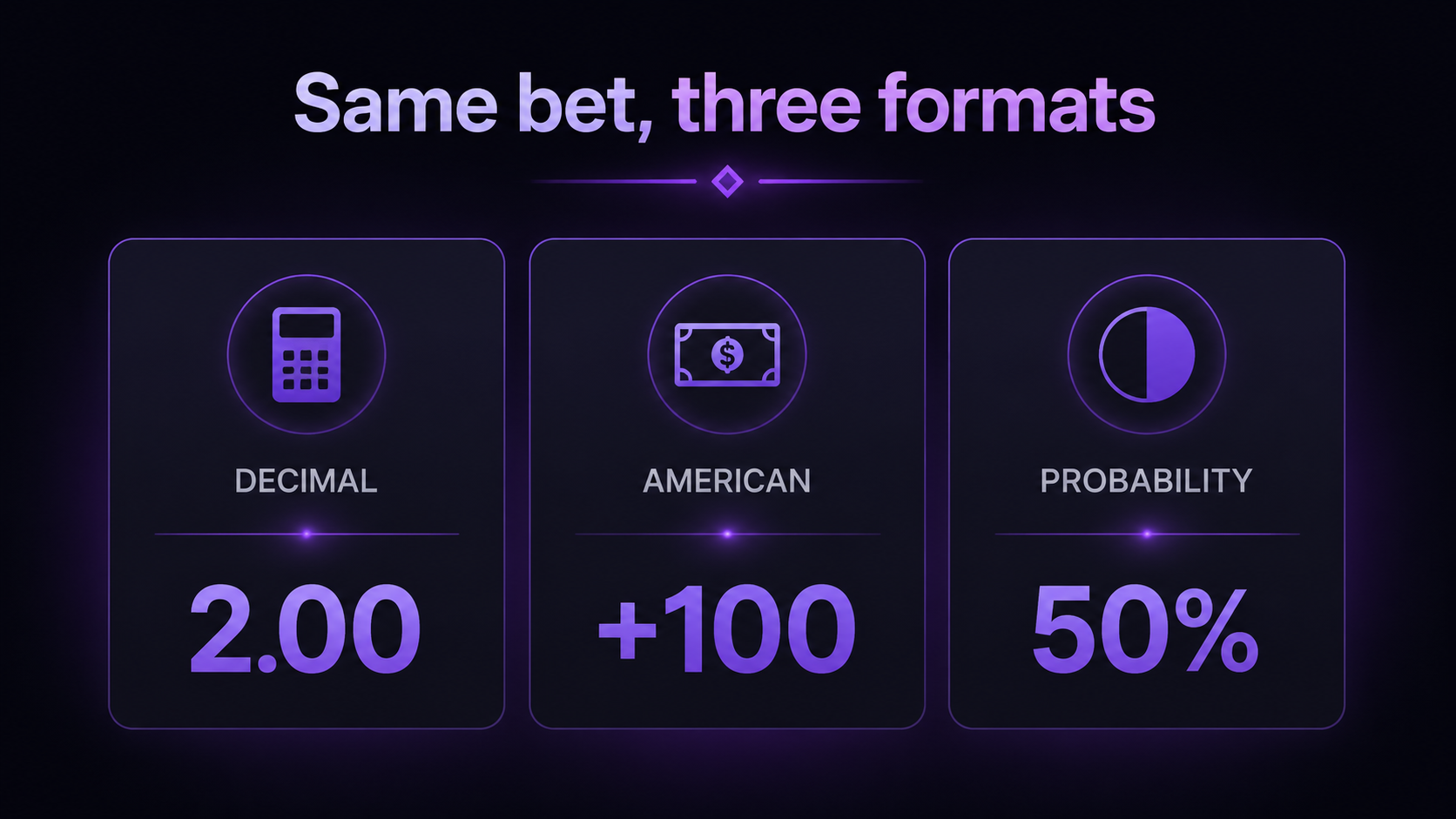
This is the one skill to actually practice. Here is the same set of example outcomes shown across all three formats, with the implied probability worked out. These numbers are illustrative, not live prices for any real team.
| Decimal | American | Polymarket price | Implied probability |
|---|---|---|---|
| 1.25 | -400 | ~$0.80 | ~80% |
| 1.45 | -222 | ~$0.69 | ~69% |
| 1.80 | -125 | ~$0.56 | ~56% |
| 2.00 | +100 | ~$0.50 | 50% |
| 2.75 | +175 | ~$0.36 | ~36% |
| 3.50 | +250 | ~$0.29 | ~29% |
The three formulas worth memorising:
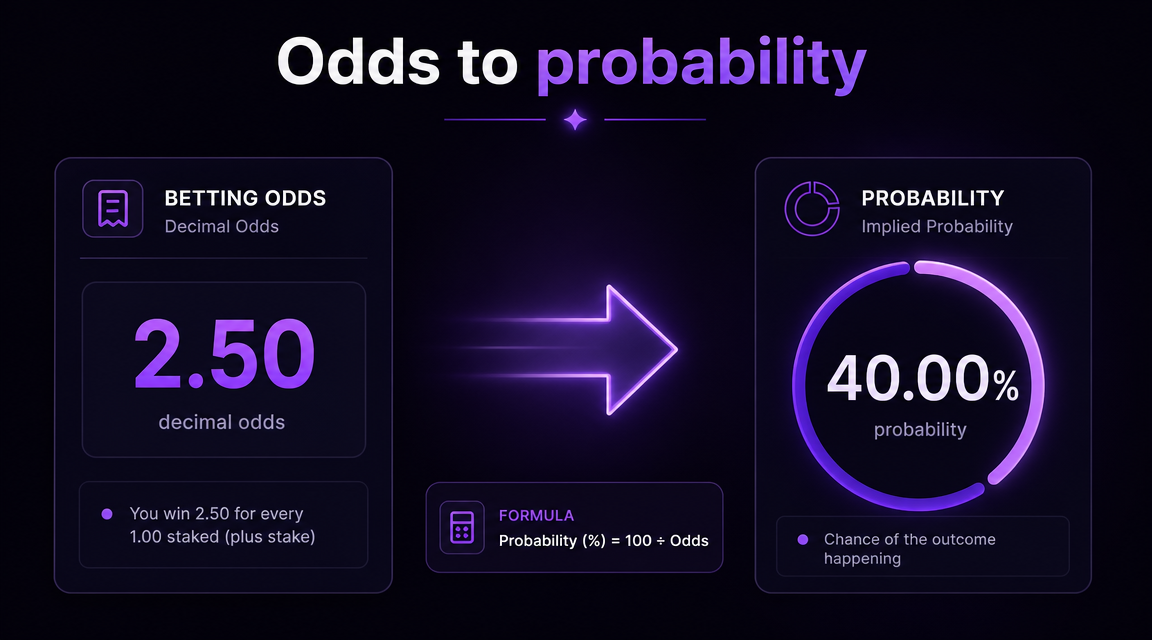
- Decimal to probability: 1 divided by the decimal odds. 1 / 2.00 is 0.50, so 50 percent.
- Positive American to probability: 100 divided by (the number plus 100). For +200 that is 100 / 300, about 33 percent.
- Negative American to probability: the number divided by (the number plus 100). For -200 that is 200 / 300, about 67 percent.
For Polymarket there is nothing to convert. A price of 0.40 is 40 percent. That simplicity is the whole point of a prediction market: the board already speaks in probabilities.
How Polymarket prices a team as a live 0 to 100 percent share
Polymarket runs a peer-to-peer order book, so you are trading with other people, not against a house. According to Polymarket's documentation, prices are not set by the platform; they emerge from supply and demand as users buy and sell. Every outcome is a share priced between 0 and 1 dollar, and that price directly represents the market's belief in the probability of that outcome.
The displayed number is usually the midpoint of the best bid and the best ask. Polymarket's docs give a clean example: if the best bid for an outcome is 0.34 and the best ask is 0.40, the displayed price is (0.34 plus 0.40) divided by 2, which is 0.37, or a 37 percent probability. If the spread is wider than 0.10, the platform shows the last traded price instead. When you actually trade, you pay the ask to buy and receive the bid to sell, so the midpoint is a reference point rather than a guaranteed fill.
There is one more elegant property. A Yes and a No share together are fully backed by 1 dollar of collateral, and the two prices sum to about 1.00. If a team's "wins the series" share trades at 0.62, the "does not win" side sits near 0.38. Because they add up to one, the prices behave like clean probabilities with no bookmaker overround stapled on top. You can also exit any time before the event resolves by selling your shares back into the market to lock in a profit or cut a loss.
See live LoL odds priced as real probabilities.
Open PolymarketA worked example: is 35 cents a good price?
Say it is the playoffs and a team we will call the underdog is trading at 0.35 on a "wins this series" market. Straight away you know the market gives them roughly a 35 percent chance, and their opponent the complementary 65 percent. No conversion needed.
Now do the only thing that matters: compare that to your own estimate. Suppose you have watched both teams all split, you think the underdog matches up unusually well in the current patch, and you honestly believe they win this series closer to 45 times out of 100. The market says 35 percent, you say 45 percent. That 10 point gap is the edge. Buying shares at 0.35 when you believe the true number is 0.45 is, on paper, a value bet, because if your read is right you are being paid as if the outcome is less likely than it really is.
Flip it around. If you watched the same teams and concluded the underdog wins maybe 25 times out of 100, then 0.35 is a bad price and you would rather back the favourite or pass entirely. The price did not change; your assessment did. Value is never about the number alone, it is about the number versus your honest probability. And no edge is a guarantee. A 45 percent shot still loses more often than it wins.
Favourites, underdogs, and why prices move
The favourite is the outcome with the higher implied probability: shorter decimal odds, a minus on the American line, a price above 0.50 on Polymarket. The underdog is the mirror image, with a longer payout to compensate for the lower chance. Backing favourites wins more often but pays little; backing underdogs wins less often but pays more. Neither is "smarter" on its own, only relative to the price on offer.
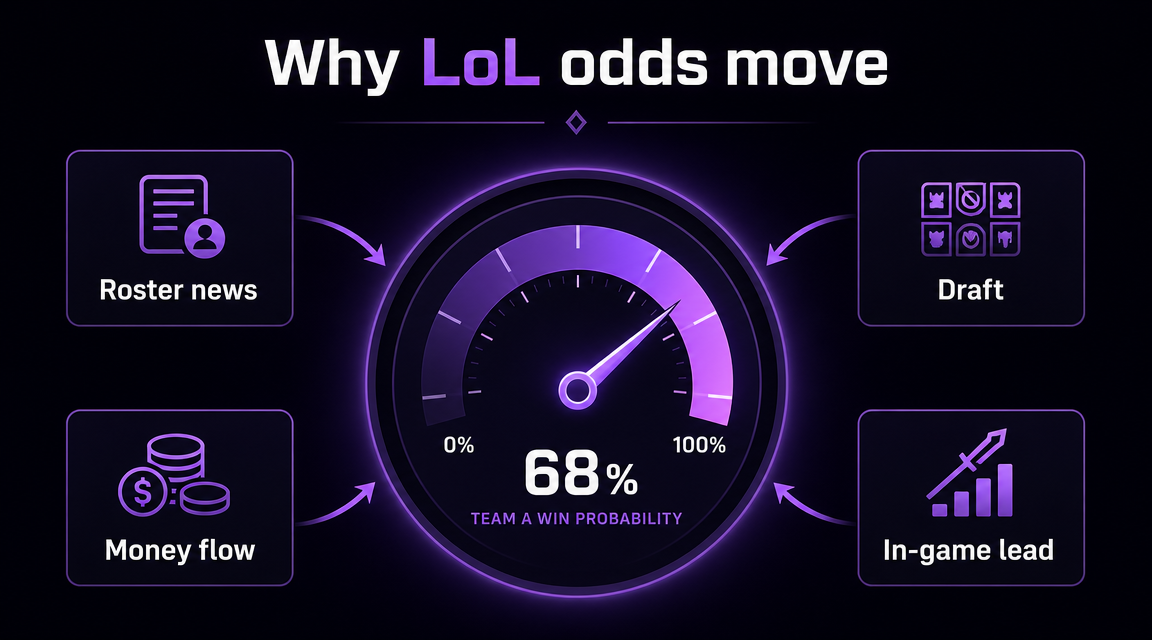
Odds are not static. On a live order book they drift constantly, and the usual culprits are:
- News and lineups. A confirmed substitute, a player on leave, or a roster change can move a price hard before a single game is played.
- Patch and meta shifts. A new patch that favours a team's style nudges their share up as traders price it in.
- Live game state. During a series, a team that wins game one will see their share jump because there are simply fewer games left for the opponent to come back.
- Money flow. Heavy buying on one side pushes that price up and the other down, the same way any market reprices when demand lands.
Watching a price move is information in itself. If a share drifts from 0.50 to 0.62 with no obvious news, the market is telling you something has shifted in the collective read. You can track how favourites firm up as a tournament unfolds on our Worlds hub, and line up the fixtures driving those moves on the match schedule.
The common LoL market types
"Who wins" is only the start. Across a season you will see a handful of recurring market types, and each has its own odds. Here is the lay of the land.
| Market type | What you are predicting | Notes |
|---|---|---|
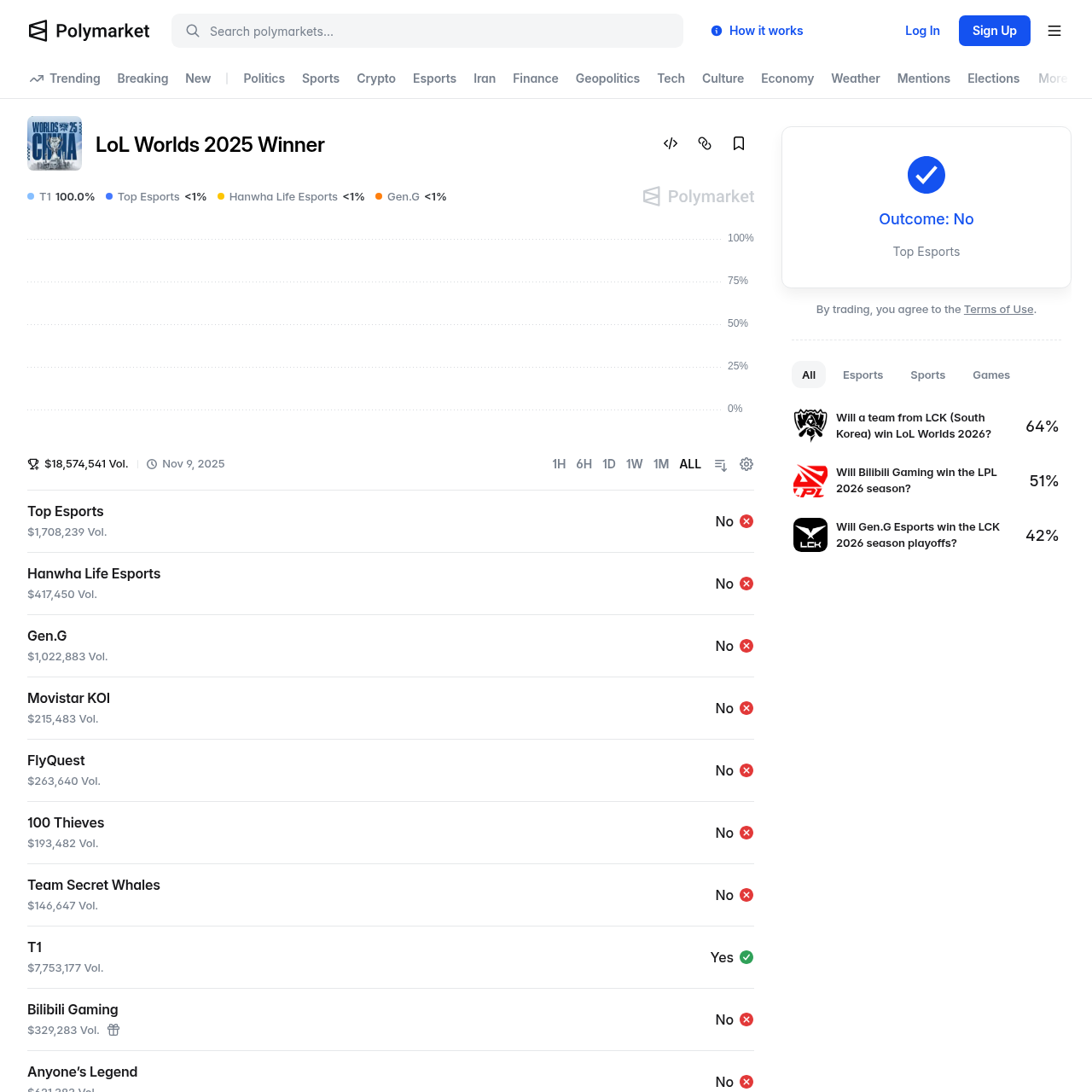
| Tournament winner (outright) | Which team lifts the trophy | Many outcomes, so even favourites can sit well under 50%. Prices shift round by round. |
| Series winner (match) | Who wins a Bo3 or Bo5 | The bread-and-butter market. Two outcomes that sum to ~100%. |
| Map / game winner | Who wins a single game in the series | Tighter than the series price because one game is more of a coin flip. |
| Map handicap (spread) | A team to win by a margin, e.g. -1.5 maps in a Bo5 | Shortens a heavy favourite's payout into a more interesting number. |
| Totals (kills, towers, time) | Over or under a line, e.g. total kills or game length | Availability varies by book and event. Driven by team pace and meta, not just who is better. |
Not every market is offered everywhere, and prediction markets tend to focus on the cleaner outright and series questions. If you are brand new to placing any of these, start with our walkthrough on how to bet on League of Legends, then use the team form on the LCK standings to sanity-check whether a favourite's price actually matches how they have been playing.
Reading odds responsibly
A clear-eyed reminder, because the maths can make this feel more certain than it is. An implied probability is a probability, not a result. A team at 0.80 still loses one time in five, and "value" only pays off across many bets, never on any single one. Tournament outrights especially can stay losers for weeks before they resolve.
Set a budget before you ever look at a price, treat it as entertainment money you can afford to lose, and never chase a loss by piling onto worse odds. Betting and prediction markets are restricted to adults (18+, 21+ in some regions) and are not legal everywhere, so check your local rules. If it ever stops being fun, step away. Groups like GamCare and BeGambleAware offer free, confidential help.
Frequently asked questions
How do you read League of Legends odds?
Identify the format first. Decimal odds show your total return per unit staked (1.50 returns 1.50 for every 1 risked). American odds use plus for underdogs and minus for favourites. Prediction-market odds like Polymarket's show the probability directly as a price between 0 and 1. Then convert whatever you see into an implied percentage so you can compare it to your own read of the match.
What does +200 mean in esports betting?
+200 is an American-odds underdog price. The plus means you win 200 on a 100 stake (a 300 total return). Its implied probability is 100 divided by (200 plus 100), which is about 33 percent. In decimal that is 3.00, and on a prediction market it sits near a 0.33 share.
How do you convert odds to a probability?
For decimal odds, divide 1 by the odds (1 / 2.50 is 40 percent). For positive American odds, do 100 divided by (the number plus 100). For negative American odds, do the number divided by (the number plus 100). For Polymarket there is nothing to do: a 0.40 share already means a 40 percent implied probability.
What are good odds in LoL betting?
Good odds are not about the number being big or small, they are about the price being better than the true probability. If you genuinely believe a team wins 45 percent of the time and the market prices them at 35 percent (a 0.35 share), that is a good price. If you think they win 25 percent and the market says 35 percent, the same price is bad. Always compare the implied probability to your own honest estimate.
Why do LoL odds change?
Prices move on new information and on money flow. Confirmed roster or substitute news, a patch that favours one team's style, the live state of a series (winning game one bumps a team's share up), and heavy buying on one side all reprice the market. On a peer-to-peer order book like Polymarket, prices emerge from supply and demand, so they update continuously.
Are prediction-market odds better than bookmaker odds?
They have one clear structural advantage: prediction-market prices read straight as probabilities and the Yes and No sides sum to about 1.00, with no bookmaker overround baked in. Bookmaker odds carry a built-in margin, so their implied probabilities total more than 100 percent. "Better" still depends on liquidity, the specific market, and your read, but for learning to think in probabilities, prediction markets are far easier to reason about.