TL;DR: The League of Legends Worlds prize pool is built from a base pot put up by Riot Games plus a crowdfunded contribution from in-game Championship skin and ward sales. The base has historically sat in the low millions, and crowdfunding pushed the largest pool to date, in 2018, up to roughly 6.45 million US dollars. The bulk of the money goes to the champion, and you can track the live "who wins Worlds" odds as probabilities on Polymarket rather than guessing.
If you have ever tried to find a straight answer to "how big is the lol worlds prize pool," you have probably hit a wall of conflicting numbers. One site quotes the base pot, another quotes the crowdfunded total, and a third quotes a single year as if it were the rule. The figures move year to year, and the way the pool is funded changed partway through Worlds history, so a lot of what gets repeated online is half right at best.
That confusion matters if you care about the event, and it matters even more if you want to bet on it. The league of legends worlds prize pool tells you what the teams are playing for, and the structure of the tournament tells you how hard it is to get there. Both feed directly into how you should read the odds when you go to bet on League of Legends Worlds.
So here is the promise: we are going to lay out what Worlds is, when it runs, how the prize pool is built and how it grew, how the money splits among the teams, and how the format actually works. Then we will show you how Polymarket lists the Worlds winner as live probabilities and how to back your pick without falling for the usual traps.
We cover League of Legends esports and prediction markets for a living at RiftOdds, and we have checked every prize figure below against public records (Wikipedia, Leaguepedia, Polygon and esports earnings trackers) rather than repeating the usual copy-paste numbers. Where a figure is approximate or year-specific, we say so. We do not invent precise numbers and we will never tell you who is going to win.
What LoL Worlds is and when it runs
The League of Legends World Championship, known to everyone as Worlds, is the annual world championship run by Riot Games. It is the culmination of the competitive season, and it is the most watched event in esports. Teams qualify through their regional leagues across the year, then meet in the autumn to fight for the title, the Summoner's Cup, and the championship prize.
Worlds runs in the back half of the year. Historically it has played out across roughly late September into early November, with the grand final landing in the first week or so of November. The 2018 final, for example, drew a peak that broke viewership records at the time, and finals since have routinely pulled tens of millions of concurrent viewers.
The tournament rotates host regions each year. Worlds 2026 returns to North America for the first time since 2022, with Los Angeles set to host the play-in stage, Allen, Texas hosting the Swiss stage plus quarterfinals and semifinals, and the grand final scheduled for New York City. If you want the live bracket and the calendar as it firms up, our Worlds hub and the match schedule are the pages we keep current.
How the lol worlds prize pool is built
This is the part most explainers get wrong, so we will be precise. The Worlds prize pool has two parts: a base pool that Riot Games puts up directly, and a crowdfunded contribution that comes from players buying specific in-game items.
The base pool is the floor. For most of the modern Worlds era it has sat in the low millions of US dollars. The crowdfunding piece is what made the total balloon in certain years. Starting in 2016, Riot announced that 25 percent of the revenue from Championship skins and ward skins sold during the Worlds window would be added to the prize pool (a parallel arrangement sends Challenger skin revenue toward the Mid-Season Invitational pool). In other words, every time fans bought a Championship skin, a slice of that purchase flowed straight into what the pros were competing for.
That mechanic is why the pool spiked. In 2016, crowdfunding lifted the total to roughly 5.07 million US dollars. In 2018, the base pool of about 2.225 million US dollars was inflated by Championship skin and ward sales to around 6.45 million US dollars, which stands as the largest single-year Worlds pool on record. The takeaway is simple: when you see a giant Worlds number, it usually includes the crowdfunded slice, not just Riot's base contribution.
It is worth noting Riot later stepped back from leaning on crowdfunding as the headline, and recent pools have been framed more around the base prize than the inflated skin-driven totals of the late 2010s. So if you are comparing a 2018 figure to a more recent one, you are not always comparing like for like.
Worlds prize pool by year (verified figures)
Here are the historical totals we were able to verify from public records. Treat these as the published pool for that edition; the funding mix (base versus crowdfunded) varies by year, as explained above.
| Year | Published prize pool (approx, USD) | Notes |
|---|---|---|
| 2011 | $100,000 | The very first Worlds, won by Fnatic. |
| 2014 | ~$2.13 million | Pre-crowdfunding era base pool. |
| 2016 | ~$5.07 million | First year crowdfunding (Championship/ward skins) was added. |
| 2018 | ~$6.45 million | Largest single-year pool on record (base ~$2.225M plus crowdfunding). |
We have left gaps where we could not confirm a clean, consistent figure rather than fill them with a guess. The pattern is what matters: a low-millions base, with crowdfunding adding the difference in the years it was emphasised, peaking in 2018.
How the Worlds prize money splits
The pool is not shared evenly. The champion takes the lion's share, and the payout tapers steeply from there. The cleanest fully documented example we have is 2016, when the roughly 5.07 million dollar pool split like this:
- 1st place: about 2,028,000 US dollars (roughly 40 percent of the pool).
- 2nd place: about 760,500 US dollars.
- 3rd and 4th: about 380,250 US dollars each.
- Remaining places (5th to 16th): the rest of the pool, in shrinking tiers down the standings.
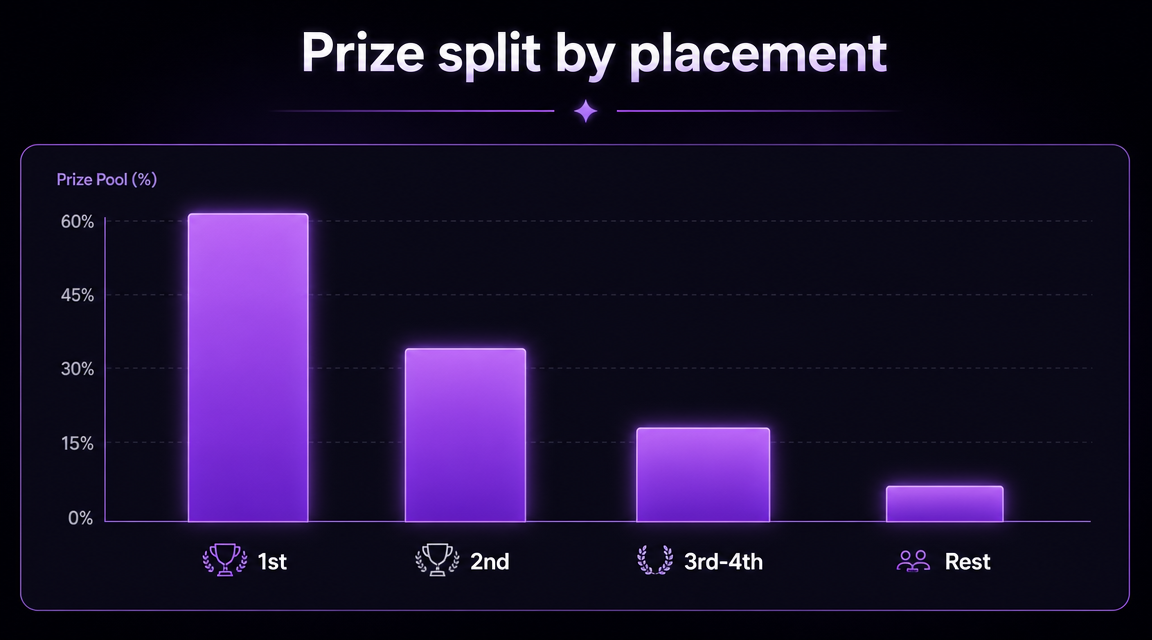
The exact percentages shift slightly year to year, but the shape is consistent: winning Worlds is worth multiples of finishing second, and the gap between fourth and the group of also-rans is large. This top-heavy structure is part of why Worlds is so volatile and so fun to follow. A single best-of-five swing can move a team across a seven-figure line.
The Worlds format, stage by stage
The format has evolved, but the modern shape is a three-act structure. Verify the current edition's exact details on the Worlds hub, since Riot adjusts slot counts and seeding most years, but the skeleton looks like this:
- Play-in stage: the lowest-seeded qualifiers fight for the final spots in the main event. This is where Cinderella runs begin. DRX famously won the whole thing from the play-in in 2022.
- Swiss stage: the main-event teams play a Swiss-system bracket, where each team is matched against opponents on a similar record. Win enough series and you advance; lose enough and you are out. It replaced the old four-group round-robin from 2023 onward.
- Knockout stage: single-elimination, best-of-five series, culminating in the grand final and the Summoner's Cup.
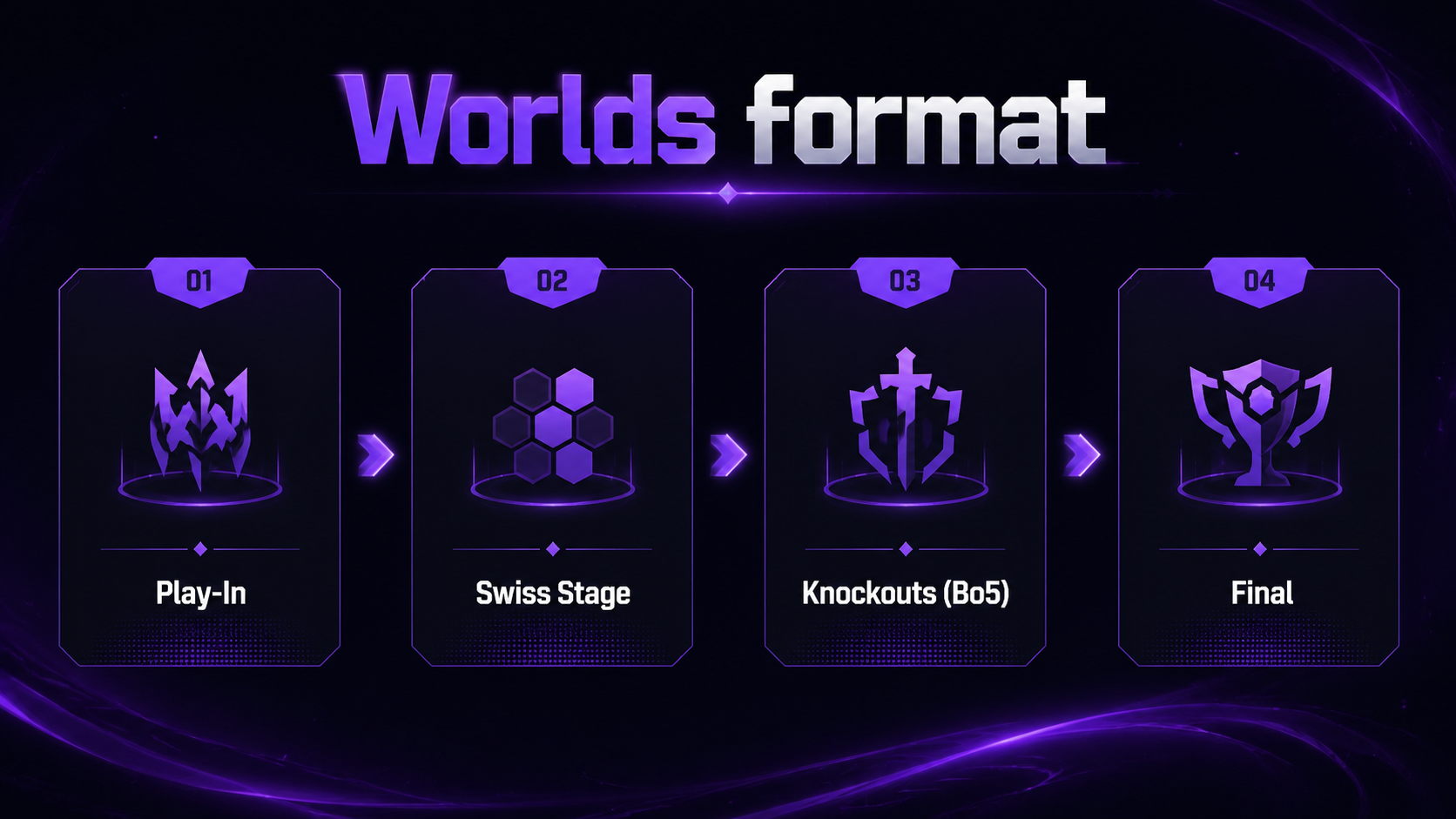
For 2026, the event spans Los Angeles (play-in), Allen, Texas (Swiss plus quarters and semis), and New York City (final), with 18 teams in the field. The Summoner's Cup itself was redesigned for 2025 and slimmed down to roughly 22 pounds so the winning roster can actually lift it.
Follow the live Worlds winner odds and back your pick.
Open PolymarketWhy Worlds is the best LoL event to bet on
We think Worlds is the single best League event to wager on, and not just because it is the biggest. A few reasons:
- Deep, liquid markets. Worlds attracts far more attention than any regular-season split, so the "who wins Worlds" market is busy. More participants generally means tighter, more meaningful prices.
- A long runway. Because the field is set well ahead and the tournament runs for weeks, the winner odds move constantly as teams advance, get eliminated, or look shaky in the Swiss stage. That gives informed fans plenty of spots to act.
- Best-of-five knockouts. The longer series in the bracket reward the genuinely better team more often than a single game would, so reading the odds against the matchups is a real skill, not a coin flip.
If you are brand new to all of this, start with our walkthrough on how to bet on League of Legends, then come back here.
How Polymarket lists the Worlds winner market
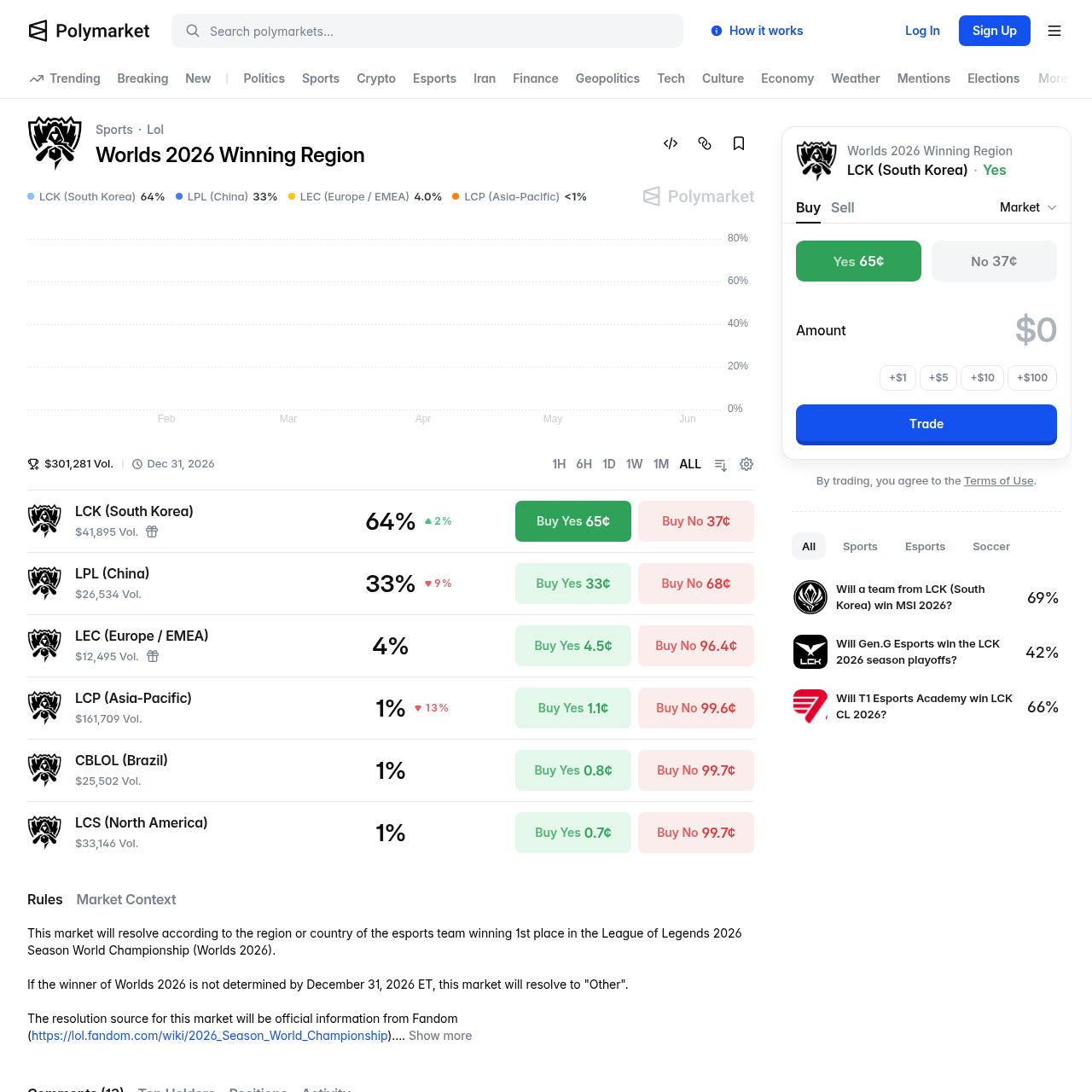
Polymarket is a prediction market, which means the "odds" are quoted as probabilities. Each team in the Worlds winner market trades as a price between 0 and 100, and that price is effectively the market's estimate of the chance that team lifts the cup. A team trading at 30 means the market thinks it has about a 30 percent chance to win Worlds.
During a live Worlds, Polymarket runs a dedicated set of League markets, including the outright Worlds winner alongside region and series markets. Those prices shift in real time as the bracket plays out, which is exactly why they are useful: you are watching the crowd's collective read update game by game.
How to read and back the Worlds market
Reading a prediction market is a different muscle from reading bookmaker odds. Here is how we approach the Worlds winner market:
- Read the price as a probability. A favourite at 45 is not a lock; it is a team the market gives a bit under a coin-flip chance to win the whole event. Roughly half the time, the 45-favourite still loses. If that feels weird, our explainer on League of Legends betting odds explained breaks down probability versus price properly.
- Compare your read to the market's. The only edge you have is disagreeing with the crowd for a good reason. If you think a Swiss-stage team is being underrated because of one bad early game, that gap is where value lives, not on backing the obvious favourite at a short price.
- Watch the swings, do not chase them. Worlds odds lurch hard after upsets. A panic move right after a result is usually the worst time to act. Decide your view before the series, not in the ten minutes after it.
- Size sensibly. The pool may be worth millions to the pros, but your stake should be money you are entirely comfortable losing.
When you are ready to actually place something, the live market lives behind our Worlds page, and you can open the winner market directly on Polymarket below.
Bet responsibly. Prediction markets are 18+ (and restricted in some regions). Odds are probabilities, not guarantees, and even a heavy favourite can crash out of the Swiss stage. Never stake money you cannot afford to lose, and treat any single result as one outcome out of many that could have happened.
Frequently asked questions
How big is the LoL Worlds prize pool?
It varies by year. The base pool that Riot Games puts up has historically sat in the low millions of US dollars, and crowdfunding from Championship skin sales pushed certain years much higher. The largest single-year pool on record was 2018, at roughly 6.45 million US dollars.
Who funds the Worlds prize pool?
Riot Games funds the base pool directly, and the rest is crowdfunded by players. Since 2016, a share of revenue (Riot set it at 25 percent) from in-game Championship skins and ward skins sold during the Worlds window has been added to the pool, so fans effectively top it up by buying cosmetics.
How is the Worlds prize money split?
Top-heavily. The champion takes the largest share, around 40 percent of the pool in the best-documented year (2016, about 2.028 million dollars), with the runner-up taking far less and the remaining teams splitting shrinking tiers down the standings.
When is LoL Worlds 2026?
Worlds runs in the autumn, typically across roughly late September to early November. The 2026 edition is in North America, with Los Angeles hosting the play-in, Allen, Texas hosting the Swiss stage plus quarters and semis, and the grand final scheduled for New York City. Check our Worlds hub for the confirmed dates.
Can you bet on LoL Worlds?
Yes. Polymarket runs a live Worlds winner market where each team trades as a probability, and the prices update in real time as the bracket plays out. It is 18+ and restricted in some regions, and odds are probabilities rather than guarantees.
What is the format of Worlds?
The modern format is three stages: a play-in stage for the lowest seeds, a Swiss-system main stage where teams are matched on record, and a single-elimination knockout bracket of best-of-five series ending in the grand final.