Key takeaways
- The Worlds 2026 play-in is four teams and one slot. It runs 15 to 18 October at the Riot Games Arena in Los Angeles, double elimination, every series a best-of-five. Three of the four are eliminated before the Swiss stage starts.
- Every route through the bracket costs three series wins. Whether a team goes undefeated or loses early and comes back, they have to win three best-of-fives. There is no two-win path.
- A team that wins 55 percent of its individual games is still only 37.8 percent to advance. The equal-field baseline is 25 percent, and you need roughly a 60 percent per-game edge before you are better than even money.
- Two of the four seats are known. Karmine Corp take the LEC's third seed and MVK Esports take the LCP's third. Polymarket prices them at 2.10 and 1.00 percent to win the whole tournament.
- The play-in tax on Karmine Corp is about three-quarters of their title equity. At the 25 percent baseline their 2.10 percent title price implies roughly 8.40 percent once they reach the Swiss stage, which is G2 territory. The entire gap is Los Angeles.
On this page
- What the Worlds 2026 play-in actually is
- The four seeds that land in Los Angeles
- Two seats are still open this weekend
- What a best-of-five does to a per-game edge
- Advance probability, priced properly
- The play-in tax on Karmine Corp
- Fearless Draft breaks the independence assumption
- What the region market says about the play-in four
- How we would read the play-in board
- Related reading
- Frequently asked questions
Every page currently ranking for the Worlds 2026 play-in tells you the same three facts: four teams, double elimination, Los Angeles. Not one of them tells you what clearing that bracket is worth, and most of them still have the field listed as "to be confirmed" for two regions that are playing the deciding series right now.
The stakes are the steepest cut at the tournament. Nineteen teams qualified for Worlds 2026 and only sixteen reach the Swiss stage, so three of them are knocked out in a four-day event in a 300-seat studio before the main tournament has played a game. A team can win its regional split, fly to California, and be finished by Sunday.
So we did the part the format explainers skip. We pulled every League of Legends contract off Polymarket's Gamma API at 21:20 UTC on 20 September 2026, took bid and ask alongside the mid on each one, added the books up, and then worked out the exact double-elimination maths rather than guessing at it. The bracket model checks out: four equally matched teams sum to precisely 100 percent.
The full nineteen-slot picture is in Worlds 2026 qualified teams, the Swiss maths that follows this stage is in Worlds 2026 format explained, and Korea's four seeds are priced in LCK Worlds 2026 odds.
What the Worlds 2026 play-in actually is
Riot's own format note describes the stage in one sentence: four teams in a double-elimination best-of-five bracket, with one team advancing to the Swiss stage. The other three are out of the tournament.
That is a harder stage than the name suggests. Previous play-ins were group stages of eight or ten teams feeding multiple slots into the main event. This one is a knockout with a 25 percent survival rate.
| Stage | Dates (2026) | Venue | Teams in | Teams out |
|---|---|---|---|---|
| Play-In | 15 to 18 October | Riot Games Arena, Los Angeles (capacity 300) | 4 | 3 |
| Swiss stage | 23 to 26 and 28 to 31 October | Credit Union of Texas Event Center, Allen, Texas | 16 | 8 |
| Quarter-finals and semi-finals | 3 to 8 November | Credit Union of Texas Event Center, Allen, Texas | 8 | 6 |
| Grand final | 14 November | Barclays Center, Brooklyn, New York (capacity 19,000) | 2 | 1 |
The arithmetic ties out. Nineteen teams qualified, four go to the play-in, fifteen go straight to Texas, and the play-in winner makes sixteen for the Swiss stage. The venue sizes tell the same story: the stage that eliminates three Worlds qualifiers happens in a room smaller than most regional studios.
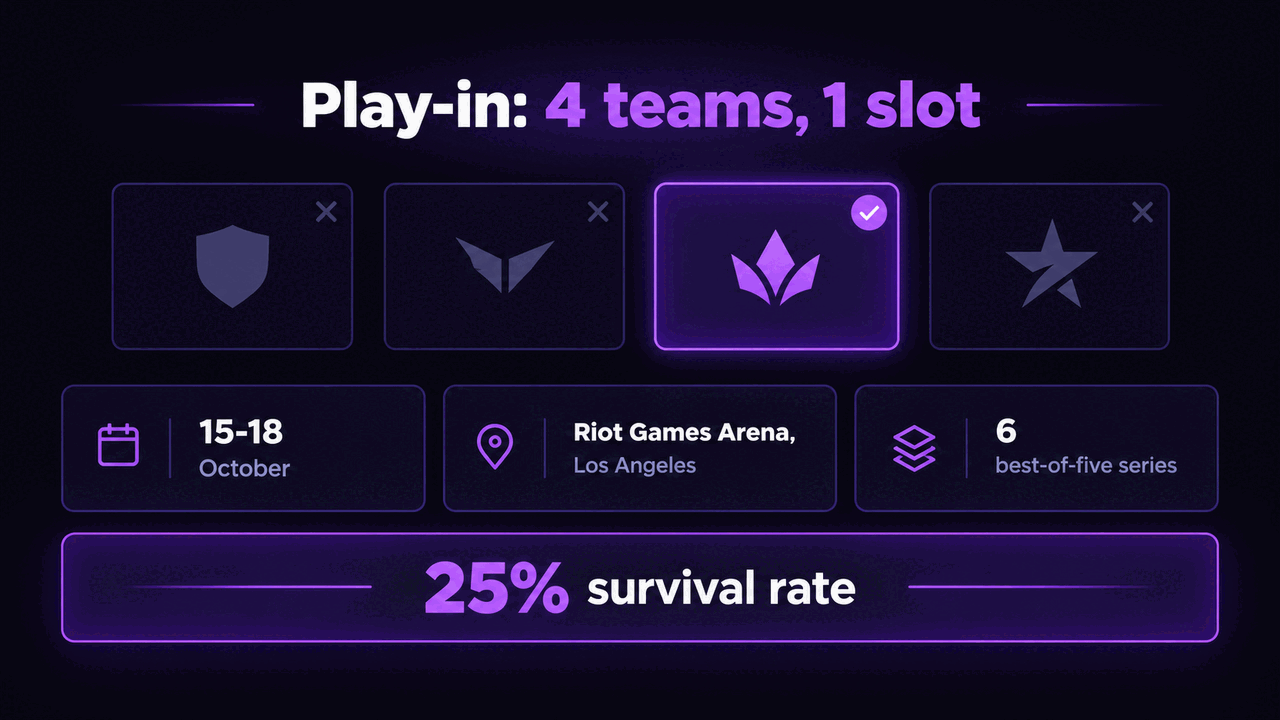
Six series get played across four days. Two opening best-of-fives, a winners' final, a losers' round, a losers' final, and a decider.
The four seeds that land in Los Angeles
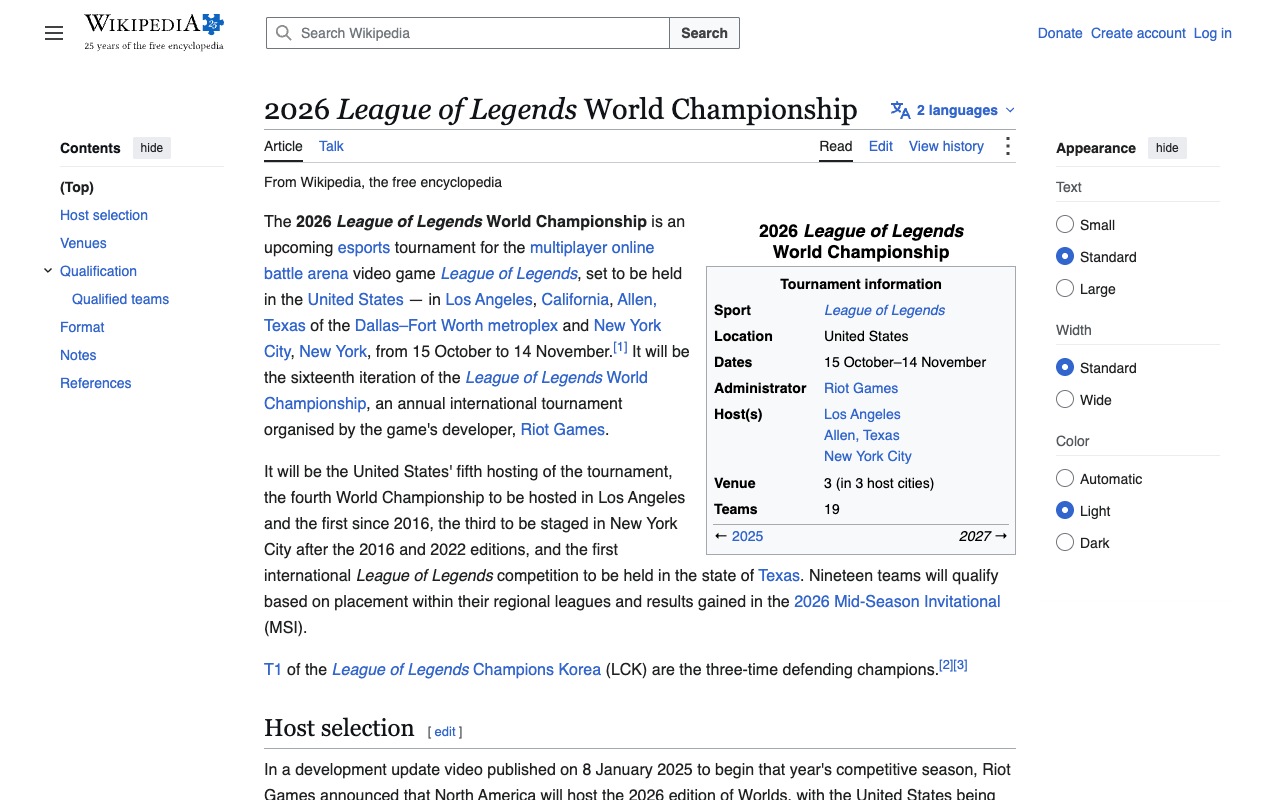
Riot changed the play-in routing for 2026, and the change is the whole story. The four teams are the third seeds of the LEC, LCS and LCP, plus the second seed of the CBLOL. Korea and China send nobody, because the LCK's four seeds and the LPL's four seeds are all routed straight into the Swiss stage.
| Seed | Team | Status | Title price (Polymarket) |
|---|---|---|---|
| LEC 3rd | Karmine Corp | Confirmed. Finished third after losing the lower-bracket final to Movistar KOI | 2.10 percent |
| LCP 3rd | MVK Esports | Confirmed. Behind Team Secret Whales and CTBC Flying Oyster | 1.00 percent |
| LCS 3rd | To be decided | Cloud9 KIA already qualified; LYON, Team Liquid, FlyQuest and Shopify Rebellion still live | No contract yet |
| CBLOL 2nd | To be decided | Playoffs in progress; LOS and LOUD lead the market | No contract yet |
One correction worth making, because it is circulating. Some coverage has the LPL's fourth seed in the play-in. It is not, and the seeding list disproves it: LCK 1 through 4, LPL 1 through 4, LCS 1 and 2, LEC 1 and 2, LCP 1 and 2, and CBLOL 1 account for fifteen direct Swiss places. Add the play-in winner and you have sixteen. Move LPL's fourth seed into Los Angeles and the Swiss stage is a team short.
Karmine Corp are the interesting name. They are the best-supported team in the bracket, they beat a Worlds semi-finalist in the LEC season, and the reward for finishing third in Europe is a trip that G2 and Movistar KOI do not have to make. Europe's route to this point is covered in LEC Playoffs 2026.
Two seats are still open this weekend
The reason nobody has published a play-in preview yet is that half the field does not exist. The Americas and Brazilian playoffs are running as we write, and Polymarket's "Team to Qualify for Worlds 2026?" market is the only live pricing on either.
| Region | Team | Qualify (mid) | Best bid | Best ask | Spread |
|---|---|---|---|---|---|
| LCS (3 slots) | Cloud9 KIA | 99.45 percent | 0.990 | 0.999 | 0.9 pts |
| LYON | 73.00 percent | 0.490 | 0.970 | 48.0 pts | |
| Team Liquid Alienware | 62.50 percent | 0.260 | 0.990 | 73.0 pts | |
| FlyQuest | 25.00 percent | 0.010 | 0.490 | 48.0 pts | |
| Shopify Rebellion | 12.50 percent | 0.010 | 0.240 | 23.0 pts | |
| CBLOL (2 slots) | LOS | 74.50 percent | 0.500 | 0.990 | 49.0 pts |
| LOUD | 60.50 percent | 0.470 | 0.740 | 27.0 pts | |
| FURIA | 25.50 percent | 0.010 | 0.500 | 49.0 pts | |
| paiN Gaming | 24.50 percent | none | 0.490 | no two-sided market |
Read the spread column before the price column. Only Cloud9's contract is tight enough to treat as a probability. Team Liquid's 62.50 percent is the midpoint of a 26-cent bid and a 99-cent ask, which is not a forecast, it is the absence of one. The same goes for LYON at 73 and LOS at 74.5.
The books do not balance either. Three LCS slots should price at 300 percent across the region's teams, and the eight Americas contracts add to 297.6. That looks healthy until you notice 25 of those points belong to a Sentinels contract with zero volume and a bid of 0.2 cents against an ask of 49.8 cents. Strip it and the book reads 272.6 for 300, with 27 points of qualification unaccounted for. Brazil goes the other way: six CBLOL teams sum to 226 percent for two slots, a 26-point overround.
There is a cleaner cross-check available in the head-to-head markets. Polymarket's series market on today's Team Liquid against FlyQuest best-of-five has Liquid at 77.5 percent, well above their 62.5 percent qualification price, which tells you the bracket has rounds left after this one. If you want to strip margin out of numbers like these yourself, our no-vig calculator does it in one step.
What a best-of-five does to a per-game edge
Here is the number most previews get wrong. A best-of-five is a probability amplifier, and people consistently underrate how much it amplifies. A team that is a coin flip per game is a coin flip per series, but every point of per-game edge above that is magnified.
The formula is straightforward. With a per-game win probability of p, a team wins a best-of-five with probability p³(1 + 3q + 6q²) where q is 1 − p, summing the 3-0, 3-1 and 3-2 routes.
| Per-game win rate | Best-of-five win rate | Edge gained |
|---|---|---|
| 40.0 percent | 31.7 percent | −8.3 pts |
| 45.0 percent | 40.7 percent | −4.3 pts |
| 50.0 percent | 50.0 percent | 0.0 pts |
| 55.0 percent | 59.3 percent | +4.3 pts |
| 60.0 percent | 68.3 percent | +8.3 pts |
| 65.0 percent | 76.5 percent | +11.5 pts |
| 70.0 percent | 83.7 percent | +13.7 pts |
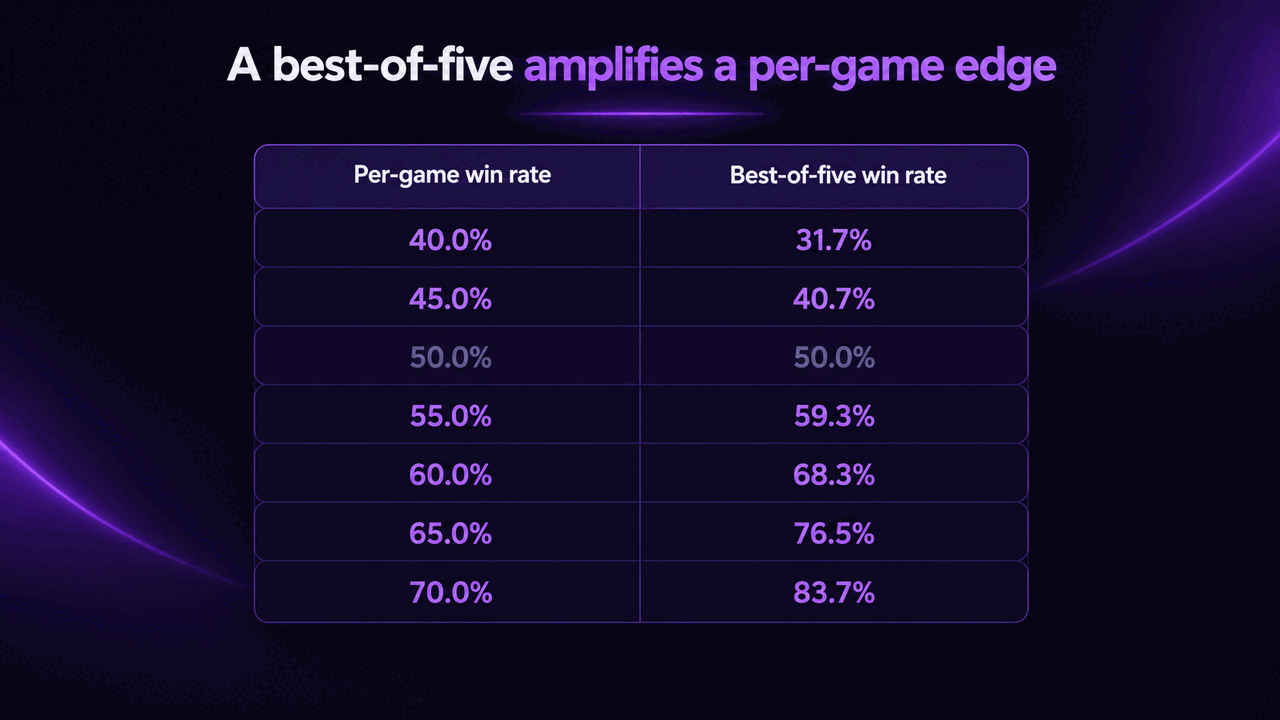
A 60 percent per-game team is a 68.3 percent series team. That is the case for the format being fair to the better side, and it is why Riot uses best-of-fives here rather than the best-of-ones that decided old play-in groups. If you want the general version of this, we walk through it in League of Legends betting odds explained.
Advance probability, priced properly
Now stack three of them. In a four-team double-elimination bracket with one survivor, every path costs exactly three series wins. Go undefeated and it is semi-final, winners' final, decider. Lose the opener and it is losers' round, losers' final, decider. Lose the winners' final and you play four series but still only win three.
That second life matters, which is why the naive answer of "cube the series probability" is wrong. Working through the bracket properly, a team's advance probability is s³(3 − 2s) where s is its best-of-five win rate against a generic opponent. The model validates: set every team to 50 percent and the four advance probabilities sum to exactly 100.
| Per-game win rate | Series win rate | Advance probability | Fair decimal | Fair American |
|---|---|---|---|---|
| 40.0 percent | 31.7 percent | 7.6 percent | 13.22 | +1222 |
| 45.0 percent | 40.7 percent | 14.7 percent | 6.79 | +579 |
| 50.0 percent | 50.0 percent | 25.0 percent | 4.00 | +300 |
| 55.0 percent | 59.3 percent | 37.8 percent | 2.64 | +164 |
| 60.0 percent | 68.3 percent | 52.0 percent | 1.92 | −108 |
| 65.0 percent | 76.5 percent | 65.8 percent | 1.52 | −192 |
| 70.0 percent | 83.7 percent | 77.7 percent | 1.29 | −349 |
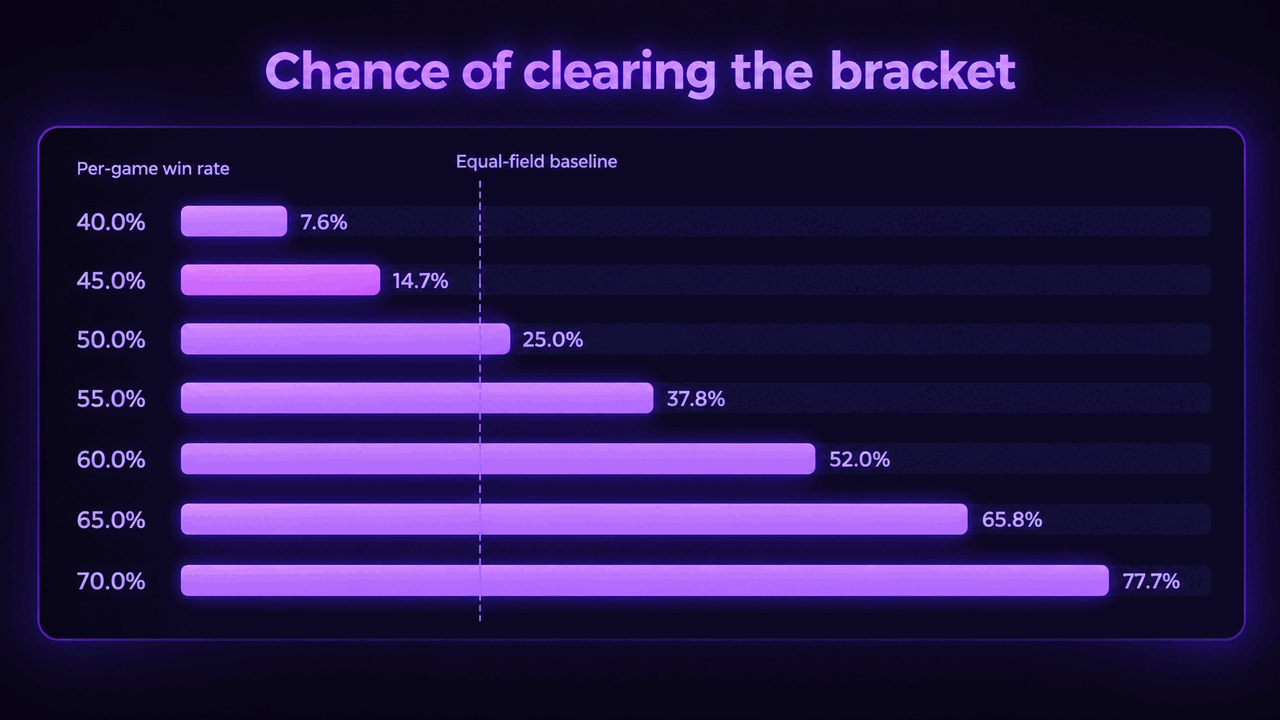
Two rows are worth sitting with. A clearly better team, winning 55 percent of its games, is still only 37.8 percent to come out of this bracket. And a side has to be a 60 percent per-game team, which at Worlds means comfortably the best side in the room, before it is better than even money to reach Texas.
When the play-in market opens, that 25 percent line is the number to anchor on. Anything priced far above it is a claim that one of these four is a class above the other three, and the regional results do not obviously support that.
The play-in tax on Karmine Corp
This is where the pricing gets genuinely useful. Karmine Corp are on Polymarket's Worlds 2026 winner market at 2.10 percent. G2 Esports, who came out of the same league and skip Los Angeles entirely, are at 6.55 percent.
Split Karmine Corp's price into its two parts. Their title probability is the chance they clear the play-in multiplied by their chance of winning Worlds once they are in the Swiss stage. Run that backwards at three different play-in assumptions.
| Assumed play-in clearance | Implied title chance once in Swiss | Versus G2 at 6.55 percent |
|---|---|---|
| 25.0 percent (equal field) | 8.40 percent | Better than G2 |
| 37.8 percent (55 percent per-game side) | 5.56 percent | Slightly below G2 |
| 52.0 percent (60 percent per-game side) | 4.04 percent | Clearly below G2 |
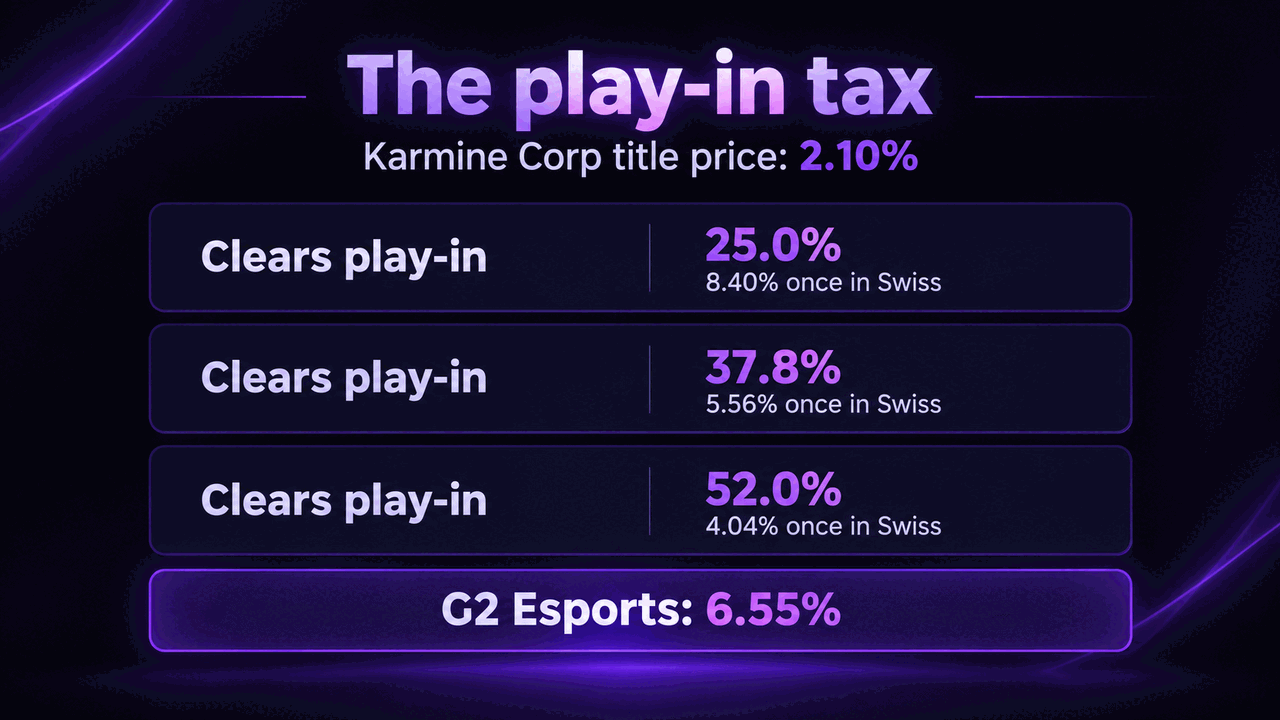
The market is not saying Karmine Corp are a bad team. It is saying they have to survive Los Angeles. On the equal-field read, the price implies a side that would be worth more than G2 in the Swiss stage, and the whole 4.45-point gap between them is the play-in. That is a real cost of finishing third rather than second in Europe, and it is the strongest argument for treating the LEC's lower-bracket final as a Worlds-deciding series rather than a seeding formality.
The caveat is the book. The winner market's listed contracts sum to 112.95 percent across ten teams, and the full market reads 612.95 because ten placeholder contracts named Team A through Team I and Other each sit at exactly 50 cents with zero volume and no bids. Nine qualified teams still have no contract. Treat the individual prices as directionally useful and the book total as noise.
Fearless Draft breaks the independence assumption
Every number above assumes each game in a series is independent, and at Worlds 2026 that is not quite true. The tournament uses Fearless Draft: once a champion is picked in a series, it is unavailable to both teams for the rest of that series.
That has a specific effect on the tails. A team with a narrow, highly practised champion pool is stronger in game one than in game five, because by game five the pool it wants has been legislated away. A team with genuine depth gains as a series goes long.
What this means in practice: read the 40 to 45 percent rows of the table above as slightly optimistic for a narrow team, and slightly pessimistic for a deep one. A single per-game number cannot capture a format that changes the game being played between game one and game five. We would rather flag that than pretend our model is more precise than it is.
It also cuts against the play-in field specifically. Four days, six possible series, and a roster that survives to the decider will have burned a lot of comfort picks getting there.
What the region market says about the play-in four
Polymarket's separate Worlds 2026 Winning Region market is the most liquid League contract on the site, with 537,000 dollars of volume against 8,675 on the outright winner. It is also close to a clean book, summing to 100.6 percent.
| Region | Price | Stripped of margin | Volume | Sends a play-in team? |
|---|---|---|---|---|
| LCK (South Korea) | 69.00 percent | 68.59 percent | $108,271 | No |
| LPL (China) | 24.00 percent | 23.86 percent | $97,546 | No |
| LEC (EMEA) | 6.10 percent | 6.06 percent | $47,527 | Yes, Karmine Corp |
| LCS (North America) | 1.10 percent | 1.09 percent | $61,715 | Yes, third seed |
| LCP (Asia-Pacific) | 0.25 percent | 0.25 percent | $180,499 | Yes, MVK Esports |
| CBLOL (Brazil) | 0.15 percent | 0.15 percent | $41,712 | Yes, second seed |
The four regions that supply the play-in field are worth 7.60 percent of the title market between them. And that 7.60 percent includes G2, Movistar KOI, Cloud9 KIA, Team Secret Whales and CTBC Flying Oyster, none of whom go anywhere near Los Angeles. The teams actually in the bracket are a rounding error on the title market.
Which is the honest case against over-thinking this stage. The play-in decides who gets eliminated in the Swiss stage instead, not who wins Worlds. The market has been consistent about that since the seeds started landing, and so has our Worlds odds tracker.
How we would read the play-in board
We do not have a play-in market to trade yet, and that is the first thing worth saying. Polymarket has a winner market, a winning-region market and a qualification market, but no bracket on the Los Angeles stage, and it is unlikely to open one until the last two seats are filled.
When it does, three rules travel well. Start at 25 percent and make the market argue you off it, because the advance model says four evenly matched teams are exactly that. Second, distrust any price built on a contract with a 40-point spread, which describes most of the qualification board this weekend. Third, remember that a play-in team's title price is two questions bolted together, and the play-in half is doing most of the work.
The one genuine edge we can see sits in the relationship rather than the outright. If Karmine Corp clear Los Angeles, their title price has to reprice upward by roughly the inverse of their clearance probability, so a 2.10 percent contract becomes something like an 8 percent one overnight on the equal-field read. That is a known, dated, structural repricing on 18 October, which is a rarer thing than a team you like.
None of this is advice. These are implied probabilities from a market that is thin in exactly the places this article is about, and the correct response to a 73-point spread is usually to do nothing. Our live board is at the Worlds hub. 18+, and please gamble responsibly.
Related reading
- Worlds 2026 format explained: Swiss stage math
- Worlds 2026 qualified teams: all 19 slots tracked
- LCK Worlds 2026 odds: Gen.G, HLE, T1 and Dplus KIA
- LCS Playoffs 2026: bracket, Worlds slots and odds
- LEC Playoffs 2026: odds, bracket and the last Worlds slot
- LoL Worlds 2026: location, dates and schedule
Frequently asked questions
When is the Worlds 2026 play-in?
The play-in stage runs from 15 to 18 October 2026 at the Riot Games Arena in Los Angeles. It is the opening stage of Worlds 2026, eight days before the Swiss stage begins in Allen, Texas on 23 October.
Which teams are in the Worlds 2026 play-in?
Four teams: the third seeds of the LEC, LCS and LCP, plus the CBLOL's second seed. Karmine Corp (LEC) and MVK Esports (LCP) are confirmed. The LCS and CBLOL seats are being decided in playoffs that are still running as of 20 September 2026.
How many teams advance from the Worlds 2026 play-in?
One. The bracket is double elimination with every series a best-of-five, and only the winner reaches the Swiss stage. The other three teams are eliminated from Worlds. That makes the play-in a 25 percent survival stage rather than the multi-slot group stage older Worlds formats used.
Why are the LCK and LPL not in the play-in?
Both regions have all four of their seeds routed directly into the Swiss stage. The LCK earned a fourth slot when Hanwha Life Esports won MSI 2026, and the LPL earned one as the second-best performing region at that event. Riot's 2026 changes were limited to the play-in format and regional seeding.
What are fair odds on a play-in team advancing?
Start at 25 percent, which is what four evenly matched teams are worth in this bracket. A side winning 55 percent of its individual games prices at 37.8 percent, and one winning 60 percent prices at 52.0 percent. The maths is s³(3 − 2s), where s is the team's best-of-five win rate.
Can you bet on the Worlds 2026 play-in on Polymarket?
Not as a standalone bracket yet. Polymarket currently lists a Worlds 2026 winner market, a winning-region market and a qualification market, and a play-in market is unlikely to open until the final two seats are filled. Play-in teams do appear in the outright winner market, where Karmine Corp sit at 2.10 percent.
Does Fearless Draft change how the play-in should be priced?
It widens the uncertainty rather than shifting the average. Champions used in a series are locked out for the rest of it, so teams with narrow champion pools are relatively stronger in game one and weaker in game five. A single per-game win rate cannot capture that, which is why we treat the model's extreme rows as approximate.
How much is the play-in costing Karmine Corp?
Roughly three-quarters of their title equity on the equal-field read. Their 2.10 percent outright price implies about 8.40 percent once they reach the Swiss stage, against 6.55 percent for G2 Esports, who qualified directly from the same league. Nearly all of the gap between the two is the Los Angeles bracket.
Prices quoted from the Polymarket Gamma API at 21:20 UTC on 20 September 2026. Format, dates and venues from Riot's MSI and Worlds updates and the 2026 World Championship record. LCP seeding from GosuGamers' report of the LCP Split 3 final.