
Key takeaways
- Cloud9 KIA and Team Liquid are already qualified for Worlds 2026. Reaching the upper-bracket final guarantees a top-three finish, and the LCS sends its top three. The market still prices them at 99.35 and 99.50 rather than 100.
- The third seed is one series, not a race. The lower-bracket semi-final winner on 26 September reaches the lower-bracket final, and that final's loser finishes third. So the last slot belongs to whoever wins LYON against FlyQuest or Shopify Rebellion.
- The same contract has two prices nine points apart. Shopify Rebellion's last trade reads 20.00 percent while its order book sits at a 10.50 percent mid, on a bid of one cent against an ask of twenty. Build a model on the wrong one and you invent an edge that is not there.
- On book mids the third-seed market is coherent to within 2.5 points. LYON, FlyQuest and Shopify Rebellion sum to 102.50 percent for one slot. On last-trade prices the same three sum to 112.50.
- North America is 0.90 percent to win the tournament, down from 2.95 on 5 September. A fall of 69 percent in under three weeks, all of it during the playoffs.
On this page
- Cloud9 and Team Liquid are already through
- The third seed comes down to one series
- The same contract has two different prices
- What a coherent third-seed book looks like
- The match markets are the disciplined ones
- Qualified is not the same as avoiding Los Angeles
- What North America is actually worth at Worlds
- The price of North America fell 69 percent
- How we would read the LCS Worlds 2026 board
- Related reading
- Frequently asked questions
If you search LCS Worlds 2026 odds today you get two kinds of page: a bracket with no prices on it, or a price list with no bracket behind it. Neither tells you the thing that decides how to read the board, which is that two of North America's three seeds stopped being uncertain five days ago.
That matters because of what is still being paid for them. Cloud9 KIA and Team Liquid are mathematically through, and their qualification contracts trade at 99.35 and 99.50 percent. The one genuinely open slot, meanwhile, is priced by a contract bid at one cent and offered at twenty.
So we did the work the bracket pages skip. We pulled every live League of Legends contract off Polymarket's Gamma API at 16:30 UTC on 24 September 2026, fetched the CLOB order book for each one rather than trusting the last-trade price, and reconstructed the lower bracket against two independent match reports.
The full nineteen-slot picture is in Worlds 2026 qualified teams, and Korea's four seeds are priced in LCK Worlds 2026 odds.
Cloud9 and Team Liquid are already through
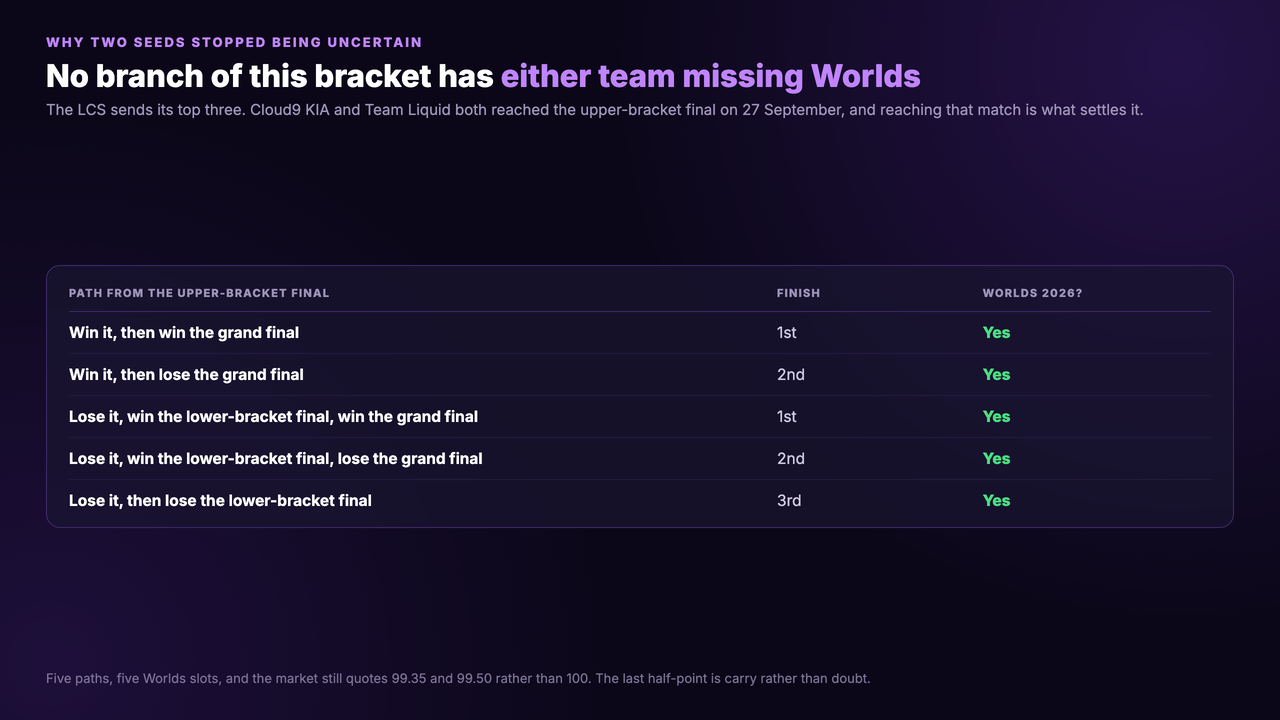
The LCS sends three teams to Worlds 2026, awarding those slots to the top three finishers in the Summer playoffs. That sounds like it needs the whole bracket to resolve. It does not.
Cloud9 beat LYON 3-1 and Team Liquid swept FlyQuest 3-0 in the upper-bracket semi-finals on 19 and 20 September. Both are now in the upper-bracket final on 27 September, and reaching that match is what settles it. The winner goes straight to the grand final, so they finish first or second. The loser drops to the lower-bracket final, whose loser finishes third.
Third is a Worlds slot. So no branch of this bracket has either team missing the tournament.
| Path from the upper-bracket final | Finish | Worlds 2026? |
|---|---|---|
| Win it, then win the grand final | 1st | Yes |
| Win it, then lose the grand final | 2nd | Yes |
| Lose it, win the lower-bracket final, win the grand final | 1st | Yes |
| Lose it, win the lower-bracket final, lose the grand final | 2nd | Yes |
| Lose it, then lose the lower-bracket final | 3rd | Yes |
Five paths, five qualifications. This is not our inference alone: the coverage that followed the semi-finals said the same thing, describing Cloud9's upper-bracket final berth as guaranteeing a top-three finish and, at worst, the number three seed.
Which leaves the pricing looking odd. A contract on a settled outcome should read 100. Cloud9 reads 99.35 and Team Liquid 99.50, on order books that are genuinely two-sided at those levels rather than stale.
That is not an error worth trading. Half a point on a market resolving in October is about what capital tied up plus a small resolution risk is worth, and you cannot buy at the mid anyway. It is a useful calibration check, though: when a market that should read 100 sits at 99.4, that is the floor of this book's precision, and nothing else on the board deserves finer resolution than that.
The third seed comes down to one series
The same logic that locks Cloud9 and Team Liquid also tells you exactly who can take the remaining slot. Reaching the lower-bracket final guarantees at worst third place, so the third Worlds seed goes to whoever wins the lower-bracket semi-final.
That is LYON against the winner of FlyQuest versus Shopify Rebellion. Sentinels are out, having lost a reverse sweep to Shopify Rebellion in the lower bracket on 18 September, and Disguised and Dignitas never made the playoffs.
| Date (2026) | Round | Series | Stake |
|---|---|---|---|
| 25 September, 20:00 UTC | Lower bracket, round 2 | FlyQuest vs Shopify Rebellion | Right to face LYON |
| 26 September | Lower-bracket semi-final | LYON vs that winner | The third Worlds 2026 seed |
| 27 September, 20:00 UTC | Upper-bracket final | Cloud9 vs Team Liquid | Seeding only, both already through |
| 3 October | Lower-bracket final | Upper final loser vs lower semi winner | Grand final place, loser is 3rd |
| 4 October | Grand final | Upper final winner vs lower final winner | LCS title and first seed |
So one best-of-five on 26 September decides North America's last Worlds place, and one best-of-five the night before decides who plays in it. Everything after that is seeding.
Polymarket's Worlds 2026 markets carry qualification contracts on all three live teams, which means the third slot is priced three different ways at once. Those three prices have to sum to 100, because exactly one of the three will take it. They do not, and how badly they miss depends entirely on which price you read.
The same contract has two different prices
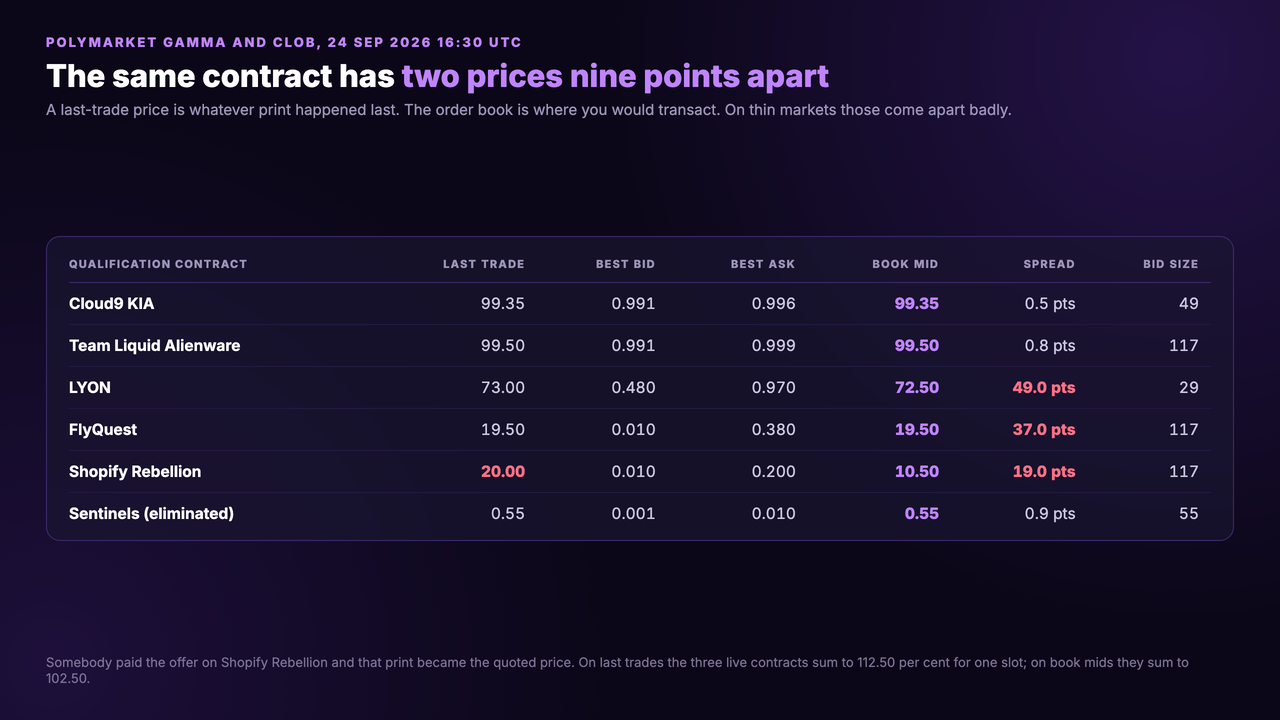
This is the part that changes the answer, so it goes before the analysis rather than in a footnote. A Polymarket contract has a last-trade price, which is what most data pulls return, and an order book, which is where you would transact. On thin markets those two come apart badly.
| Qualification contract | Last trade | Best bid | Best ask | Book mid | Spread | Bid size |
|---|---|---|---|---|---|---|
| Cloud9 KIA | 99.35 | 0.991 | 0.996 | 99.35 | 0.5 pts | 49 |
| Team Liquid Alienware | 99.50 | 0.991 | 0.999 | 99.50 | 0.8 pts | 117 |
| LYON | 73.00 | 0.480 | 0.970 | 72.50 | 49.0 pts | 29 |
| FlyQuest | 19.50 | 0.010 | 0.380 | 19.50 | 37.0 pts | 117 |
| Shopify Rebellion | 20.00 | 0.010 | 0.200 | 10.50 | 19.0 pts | 117 |
| Sentinels (eliminated) | 0.55 | 0.001 | 0.010 | 0.55 | 0.9 pts | 55 |
Look at Shopify Rebellion. The last trade says 20.00 percent. The book says you can sell at one cent or buy at twenty, so the mid is 10.50 percent. The last trade is the ask. Somebody paid the offer, that print became the quoted price, and every downstream feed now reports Shopify Rebellion at double what the book's midpoint implies.
It matters for the arithmetic. Add the three live qualification prices and the last-trade book sums to 112.50 percent for a single slot, a 12.50 point overround that looks like a badly broken market. Use book mids and the same three sum to 102.50 percent, which for a market this thin is close to respectable.
The wider book shows the same pattern: across all eight LCS teams the last-trade prices total 312.20 percent against the 300 that three slots require. Our no-vig calculator strips overround out of a book, but it cannot fix an input that was never a two-sided price.
What a coherent third-seed book looks like
Now the question worth asking. The third seed goes to the lower-bracket semi-final winner, and the series before it is priced too, so the three qualification prices are not free to be anything they like.
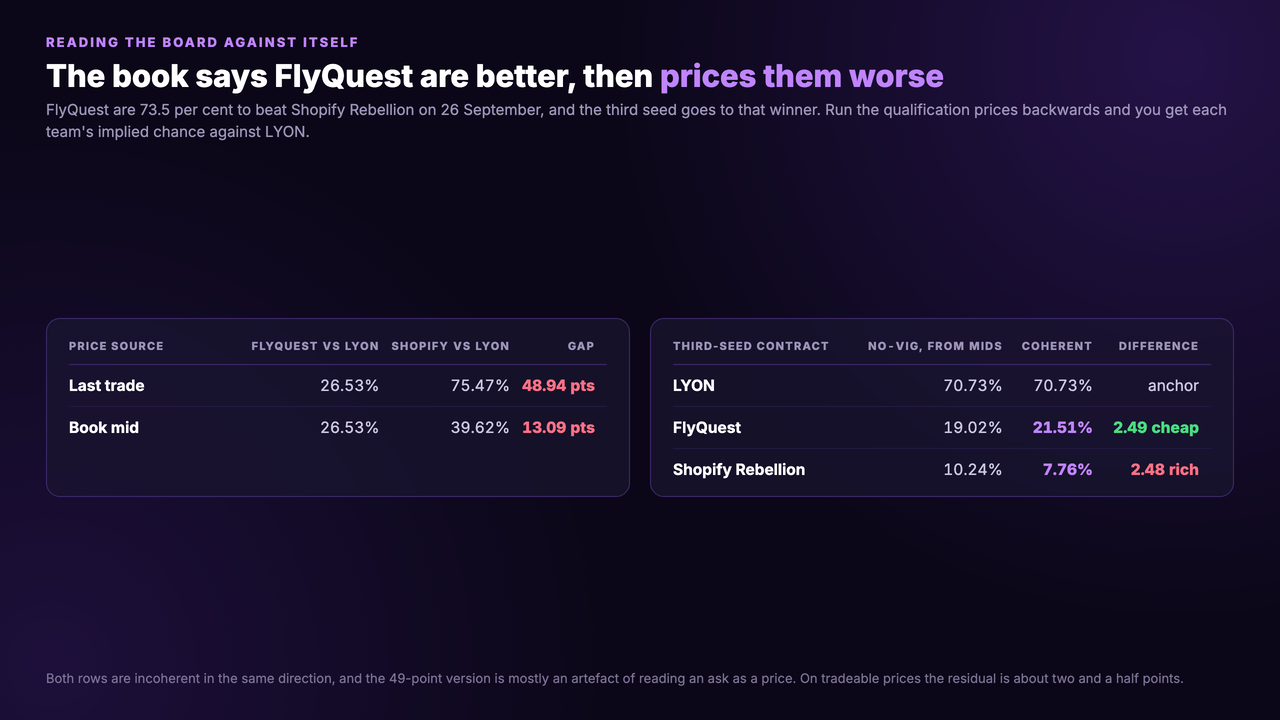
FlyQuest are 73.5 percent to beat Shopify Rebellion. So FlyQuest's chance of the third seed is 73.5 percent multiplied by their chance of beating LYON, and Shopify Rebellion's is 26.5 percent multiplied by theirs. Run that backwards from the prices and you get each team's implied chance against LYON.
| Price source | FlyQuest implied vs LYON | Shopify Rebellion implied vs LYON | Gap |
|---|---|---|---|
| Last trade | 26.53 percent | 75.47 percent | 48.94 points |
| Book mid | 26.53 percent | 39.62 percent | 13.09 points |
Both rows are incoherent in the same direction. The book says FlyQuest beat Shopify Rebellion three times in four, then says Shopify Rebellion are the better bet against LYON. Those two claims cannot both be true. If FlyQuest are the stronger side, they should be the more likely of the two to get past LYON, not less.
Set the two equal against LYON and the book resolves cleanly. LYON's no-vig share is 70.73 percent, leaving 29.27 to split between the other two in the ratio the match market gives.
| Third-seed contract | Market (no-vig, from mids) | Coherent with the match market | Difference |
|---|---|---|---|
| LYON | 70.73 percent | 70.73 percent | anchor |
| FlyQuest | 19.02 percent | 21.51 percent | 2.49 points cheap |
| Shopify Rebellion | 10.24 percent | 7.76 percent | 2.48 points rich |
So the honest version of the finding is small. FlyQuest look about two and a half points underpriced for the third seed and Shopify Rebellion about two and a half points over, once you use prices you could actually trade at. The 49 point contradiction in the last-trade data is mostly an artefact of reading an ask as a price.
One caveat we will not paper over: setting both teams equal against LYON is a modelling choice, not a fact. LYON may genuinely match up better against one of them. It is the right default when nothing prices the matchup, but a two and a half point edge sits well inside the range that assumption could be wrong by.
The match markets are the disciplined ones
It is worth showing why we trust the series prices more than the qualification prices, because the conclusion above leans on it entirely. Polymarket lists a per-game market for each game of both series, and those give an independent check on the series price.
If a team wins each game with probability p, its chance of winning a best-of-five is p³(6p² − 15p + 10). Feed in the average of the games one to three prices and compare.
| Series | Game 1 | Game 2 | Game 3 | Average | Best-of-five model | Series market |
|---|---|---|---|---|---|---|
| FlyQuest vs Shopify Rebellion | 63.0 | 62.0 | 62.0 | 62.33 | 72.20 percent | 73.50 percent |
| Team Liquid vs Cloud9 | 56.0 | 53.0 | 56.0 | 55.00 | 59.31 percent | 62.50 percent |
FlyQuest's series price sits 1.30 points above what its own game markets imply, and Team Liquid's 3.19 points above. Both gaps point the same way, which is what you expect: the favourite's series price carries a little more than the naive independent-games model, partly because the stronger side adapts across a series and partly because the game four and five markets are conditional and cannot be averaged in.
The point is that these books hang together to within about three points across two series and eight contracts, without being told to. The qualification book on the same teams does not. When two markets on one event disagree, build on the one with tighter spreads and internal consistency. Why a best-of-five compresses a per-game edge is worked through in Worlds 2026 format explained.
Qualified is not the same as avoiding Los Angeles
Here is the detail almost every LCS Worlds preview gets wrong, including the ones that correctly say Cloud9 and Team Liquid are through. Qualified and safe are different things, because the LCS third seed does not go straight to the tournament proper.
Worlds 2026 seats nineteen teams but only sixteen reach the Swiss stage. The LCS first and second seeds fly to Texas. The LCS third seed goes to the play-in in Los Angeles: four teams, double elimination, one survivor. Three of the four are out before the Swiss stage begins.
And the third seed is not necessarily the lower-bracket semi-final winner. If the upper-bracket final loser goes on to win the lower-bracket final, Cloud9 and Team Liquid finish first and second and the lower semi winner is third. But if the lower semi winner wins that final instead, they reach the grand final, and it is Cloud9 or Team Liquid who finishes third and flies to Los Angeles.
| Who wins the lower-bracket final on 3 October | 1st and 2nd | 3rd seed, to the play-in |
|---|---|---|
| The upper-bracket final loser (Cloud9 or Team Liquid) | Cloud9 and Team Liquid | The lower semi winner |
| The lower semi winner (LYON, FlyQuest or Shopify Rebellion) | One of Cloud9 or Team Liquid, plus that team | The other of Cloud9 or Team Liquid |
Nothing on Polymarket prices the lower-bracket final yet, so there is no number to quote on that second row. But it is the branch that would move the Worlds board, because the gap between a direct Swiss place and a play-in seat is most of a team's title equity. We put that cost at roughly three quarters of it in Worlds 2026 play-in odds.
What North America is actually worth at Worlds
Set the bracket aside and ask the simpler question: what does the market think North America will do once it gets there? Two ways to read that, and only one carries a usable number.
The winning-region market is the deepest League of Legends book on the platform, with 558,398 dollars of volume against 32,957 on the qualification market.
| Region | Win Worlds 2026 | Market volume (USD) |
|---|---|---|
| LCK (South Korea) | 69.50 percent | 115,467 |
| LPL (China) | 24.50 percent | 102,034 |
| LEC (Europe and EMEA) | 6.20 percent | 51,456 |
| LCS (North America) | 0.90 percent | 63,932 |
| LCP (Asia-Pacific) | 0.20 percent | 182,251 |
| CBLOL (Brazil) | 0.15 percent | 43,259 |
| Book total | 101.45 percent | |
A 1.45 point overround across six contracts is tight by any standard, and it holds up against a separate market: a contract on whether any Western team wins Worlds 2026 trades at 7.00 percent, while the LEC, LCS and CBLOL prices sum to 7.25. Two independent books, a quarter of a point apart. That is a market that has been thought about.
The team-level book is the one to distrust. In the outright winner market Cloud9 and Team Liquid both sit at 0.05 percent, which is Polymarket's minimum tick, and the LCS third seed has no contract at all yet. Add the two priced North American teams and you get 0.10 percent against the region market's 0.90, a factor of nine.
That gap is not an arbitrage, and it would be careless to present it as one. A 0.05 percent tick floor means the team market cannot quote a side at 0.3 percent, so every longshot rounds to the floor and a region's teams understate it by construction. The lesson is narrower and more useful: for a weak region, only the region market carries a real number.
The price of North America fell 69 percent
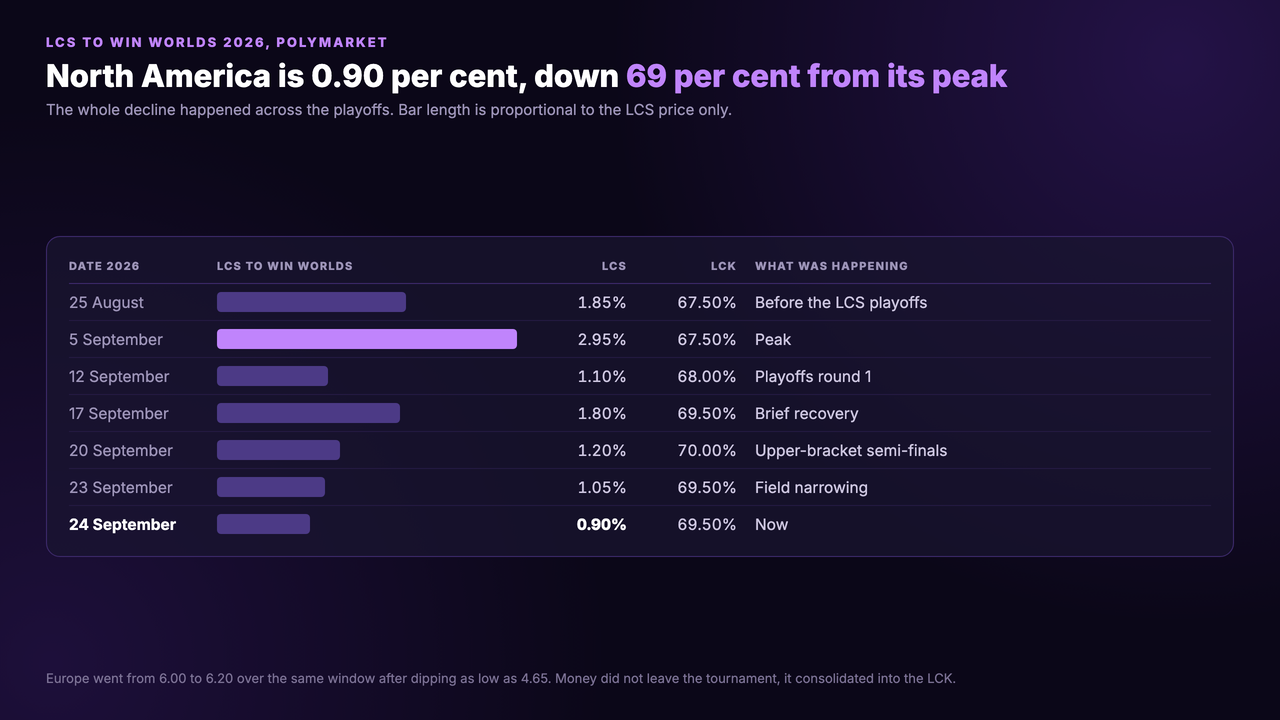
The 0.90 percent is not where this market has been sitting. North America was worth more than three times as much three weeks ago, and the entire decline happened across the playoffs.
| Date (2026) | LCS to win Worlds | LCK to win Worlds | What was happening |
|---|---|---|---|
| 25 August | 1.85 percent | 67.50 percent | Before the LCS playoffs |
| 5 September | 2.95 percent | 67.50 percent | Peak |
| 12 September | 1.10 percent | 68.00 percent | Playoffs round 1 |
| 17 September | 1.80 percent | 69.50 percent | Brief recovery |
| 20 September | 1.20 percent | 70.00 percent | Upper-bracket semi-finals |
| 23 September | 1.05 percent | 69.50 percent | Field narrowing |
| 24 September | 0.90 percent | 69.50 percent | Now |
From the 5 September peak that is a fall of 69 percent, and from a month ago it is 51 percent. Over the same window Korea went from 67.50 to 69.50 and Europe went from 6.00 to 6.20 after dipping as low as 4.65. Money did not leave the tournament, it consolidated into the LCK.
We would not read too much intent into the shape of it. The sharpest leg, 2.55 down to 1.10 between 9 and 12 September, is a 57 percent drawdown in three days on a contract priced under three cents, and a move that size at that price is as likely to be one participant adjusting a position as a collective revision. What the series does establish is persistence: twelve of the last twenty sessions closed lower against five higher, and the price has not closed above 1.80 since 17 September. The live board is on the Worlds hub, the domestic table at LCS standings.
How we would read the LCS Worlds 2026 board
Four conclusions, in the order we would act on them.
Treat Cloud9 and Team Liquid as settled. They are at 99.35 and 99.50 on outcomes with no losing branch. There is no trade there, the last half-point is carry rather than doubt, and the 27 September match between them decides seeding only.
The only live question is the 26 September lower-bracket semi-final. One best-of-five hands over North America's third Worlds seed. If you want LCS exposure at Worlds 2026, that is the event, and the series market prices it properly where the qualification market does not.
Read the book, not the last trade. Shopify Rebellion at 20.00 percent and Shopify Rebellion at 10.50 percent are the same contract on the same afternoon, and the difference between them is the difference between a 49 point contradiction and a 13 point one. On the tradeable prices the residual mispricing is about two and a half points in FlyQuest's favour, which is real but thin.
Do not size any of this. The spreads are the whole story: 49 points wide on LYON, 37 on FlyQuest, 19 on Shopify Rebellion, with between 29 and 117 contracts on the bid, against a region market 0.2 points wide with 96,449 bid. A two and a half point theoretical edge behind a 19 point spread is a rounding error with a bid-ask tax on top, and the correct response is usually to do nothing. Our reasoning is in the methodology. 18+, and please gamble responsibly.
Related reading
- LCS Playoffs 2026: bracket, Worlds slots and odds
- Worlds 2026 qualified teams: all 19 slots tracked
- Worlds 2026 play-in odds: 4 teams, 1 slot
- LCK Worlds 2026 odds: Gen.G, HLE, T1 and Dplus KIA
- LPL Worlds 2026 odds: only one seed has a price
- LoL Worlds 2026: location, dates and schedule
Frequently asked questions
Which LCS teams have qualified for Worlds 2026?
Cloud9 KIA and Team Liquid Alienware are through. Both reached the upper-bracket final of the LCS Summer playoffs, which guarantees a top-three finish, and the LCS sends its top three to Worlds. The third qualifier is the winner of the lower-bracket semi-final on 26 September, between LYON and the winner of FlyQuest against Shopify Rebellion.
How many Worlds 2026 slots does the LCS get?
Three, out of nineteen places in total. The LCK and LPL get four each, the LEC and LCP three each, and the CBLOL two. The LCS first and second seeds go directly to the Swiss stage in Allen, Texas, while the third seed starts in the play-in stage in Los Angeles.
What are the LCS Worlds 2026 odds on Polymarket?
On qualification, Cloud9 KIA are 99.35 percent and Team Liquid 99.50 percent, with LYON at a 72.50 percent book mid, FlyQuest at 19.50 and Shopify Rebellion at 10.50. On winning the tournament, the LCS as a region trades at 0.90 percent. All prices are book mids as of 16:30 UTC on 24 September 2026.
Why is North America only 0.90 percent to win Worlds 2026?
Because the market rates the region gap as very large and the history supports it. No North American team has ever reached a Worlds final, and Cloud9's semi-final run in 2018 remains the best result any LCS side has managed. The LCK trades at 69.50 percent and the LPL at 24.50, which leaves just 7.45 points spread across the other four regions.
Why do two sources quote different odds for the same team?
Because one reports the last trade and the other the order book. On a thin contract those diverge sharply: Shopify Rebellion's last trade reads 20.00 percent while the book is one cent bid against twenty cents offered, a 10.50 percent mid. If a single buyer pays the offer, that print becomes the quoted price everywhere even though nobody will sell you more at it.
When is the LCS Worlds 2026 third seed decided?
On 26 September 2026, in the lower-bracket semi-final. LYON face the winner of FlyQuest against Shopify Rebellion, played on 25 September at 20:00 UTC. Whoever wins on the 26th reaches the lower-bracket final and is guaranteed a top-three finish and a Worlds place.
Could Cloud9 or Team Liquid still end up in the play-in?
Yes, and it is the most overlooked branch on the board. Qualification is settled for both, but seeding is not. If the lower-bracket semi-final winner goes on to win the lower-bracket final on 3 October, they reach the grand final and whichever of Cloud9 or Team Liquid lost the upper-bracket final finishes third. The third seed starts in Los Angeles, where only one of four teams survives.
Sources. Region prices from the Worlds 2026 winning region market; format, dates and slot allocation from the 2026 World Championship record; LCS results as reported by Field Level Media. Every price is a book mid pulled at 16:30 UTC on 24 September 2026 and will have moved since.